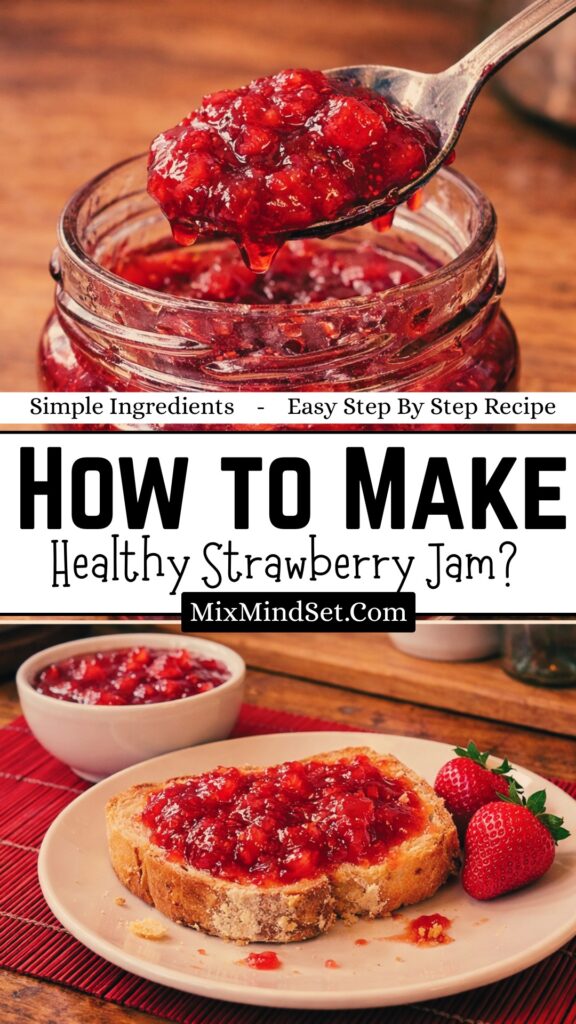
Easy Strawberry Jam Recipe
Today I’m going to show you how to make strawberry jam at home. Yes, I know… it’s much easier to buy it at the store, and there are some exceptional strawberry jams out there, but the value of making it yourself is unique.
Plus, you can adjust the sugar level to your liking (even making sugar-free jam) and give it a personal touch. This time I’ve added pink peppercorns to the recipe, but you could also use cinnamon or vanilla, for example.
Now that we’re in the middle of strawberry season, we can make a large batch of homemade strawberry jam and store it for the rest of the year.
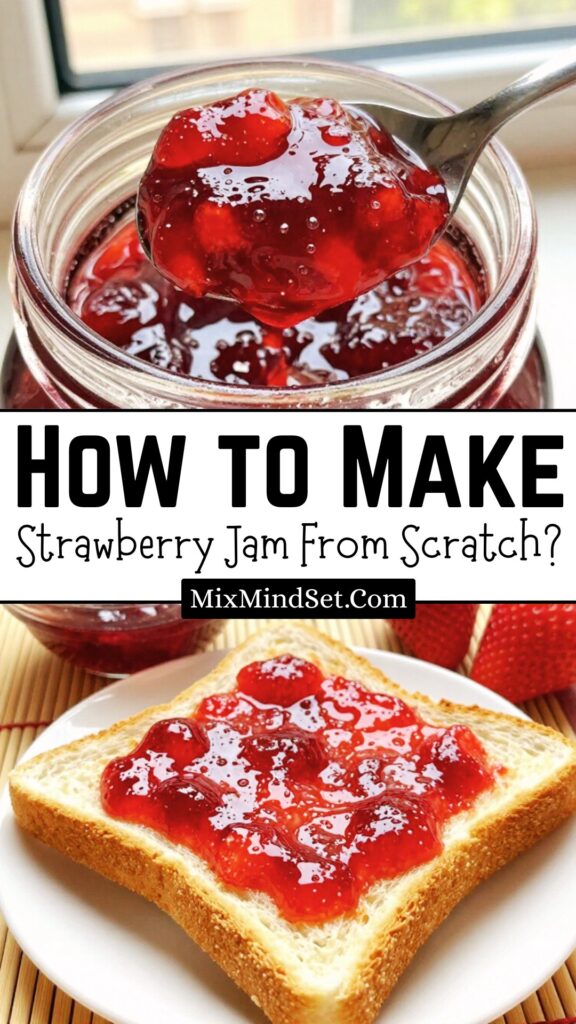
You can also make it and give it as a gift; it’s a lovely handmade present. To decorate the jars, I added a piece of fabric to the lid with an elastic band and tied it with ribbon around the edge.
Table of Contents
Tips for Perfect Strawberry Jam:
- If the strawberries don’t completely break down during cooking, you can blend them a little with a hand blender. Just be careful not to make it too runny.
- The jam will keep for up to 6 months if stored in a dark, cool, and dry place. It will keep for one week in the refrigerator once opened.
- If instead of using regular sugar we use brown sugar, it will have a nicer color and will be healthier.
What to Keep in Mind When Making Homemade Jam?
To make delicious jam, it’s important to know the correct amount of pectin in each fruit to achieve the right consistency. Pectin acts as a thickener and can be obtained in two ways:
- Chemically
- Naturally
Strawberries are a fruit with little pectin, so to achieve the right thickness you either:
- Add a lot of sugar, or
- Use gelling sachets (as mentioned here), which give a great result.
How to make Homemade Strawberry Jam?
Ingredients (table)
| Ingredient | Amount | Notes |
|---|---|---|
| Strawberries (without leaves), washed and cut | 500 g | Remove leaves and stems; cut into pieces |
| White sugar | 300 g | Variable: 150–450 g depending on ripeness and taste |
| Lemon juice | 15 ml (1 tbsp) | Use as listed (a squeeze) |
Instructions
- Check the Notes below to determine, based on your tastes and the ripeness of the fruit you’ve chosen, the amount of sugar you need.
- Wash your chosen fruit thoroughly (in this case, strawberries) and pat dry. Remove the leaves and cut off the stems. Slice the strawberries in half, and then cut each half into two or three pieces, as shown in the video.
- Place them in a medium saucepan along with the sugar and a squeeze of lemon juice and bring to a medium heat. Stir occasionally until it begins to boil.
- Once it starts to bubble, reduce the heat slightly to medium-low and stir regularly to prevent it from sticking to the bottom. Now it’s just a matter of waiting for the fruit’s water to evaporate and the jam to thicken.
- The cooking time varies depending on the quantity you make. The more you make, the longer it will take. For the quantities given (like those in the video), it will take about 45 minutes, but be guided by the texture you achieve and like rather than by the time.
- Keep in mind that it will thicken as it cools. When you finish making it and store it in the jar(s), it will be more liquid than the next day, especially if you keep it in the refrigerator.
Choose your final texture
You also need to decide on the final texture you want for your jam:
- As is, directly with the small pieces that can still be seen at the end of the process
- Mash it a little with a utensil and leave some texture
- Blend it with an immersion blender or food mill
- Pass it through a sieve to remove any seeds or lumps (as shown in the video)
Storage
Make sure your glass jars are perfectly clean and dry; you can even boil them beforehand.
- You can store your jam in the refrigerator for up to two weeks, or freeze it for up to three months.
- If you want to store it for a long time at room temperature, you need to create a vacuum seal in the jars. To do this:
- Fill the jars, leaving a little space, and seal tightly.
- Boil them for 20 minutes in a pot where they are completely submerged in water.
- Once at room temperature, store them with the date written on them so you know when they were made.
- If the vacuum seal is done correctly, they can be stored for up to two years.
Video Guide 📺
Notes
The most important thing in this recipe is the balance of fruit and sugar, which is entirely variable according to your tastes and needs—and even more so, according to the ripeness of the fruit. The riper the fruit you choose, the less sugar you will need since the fruit will naturally contain more sugar.
Many commercially produced jams use low-quality or underripe fruit, which is less sweet, so they use practically the same weight of sugar as fruit. This is completely unnecessary if you make it at home, where you have the opportunity to choose good fruit at its ideal ripeness. For me, the perfect time is when it’s ripe, without being overripe.
If you have a really sweet tooth and/or your fruit is underripe, use between 300 and 450 g of sugar for every 500 g of fruit. If you don’t have such a sweet tooth and/or your fruit is perfectly ripe, use between 150 and 300 g of sugar for every 500 g of fruit.
How to Preserve Strawberry Jam?
If you want to preserve strawberry jam for a long time, the best thing to do is sterilize the jars once they’re sealed. To do this:
- Place the sealed jars in a pot and cover them with water.
- Put a cloth at the bottom and between the jars to prevent them from bumping against each other.
- Bring the water to a boil and leave them for about 20 to 30 minutes.
This way, they’ll last a long time.
Nutritional Facts (estimated)
Estimated nutrition table (per 1 tablespoon, ~20 g)
| Nutrient | Amount (approx.) |
|---|---|
| Calories | 40 kcal |
| Carbohydrates | 10 g |
| Total sugars | 10 g |
| Fiber | 0.3 g |
| Protein | 0.1 g |
| Fat | 0 g |
| Sodium | 0 mg |
Estimated nutrition table (per 100 g)
| Nutrient | Amount (approx.) |
|---|---|
| Calories | 200 kcal |
| Carbohydrates | 50 g |
| Total sugars | 50 g |
| Fiber | 1.5 g |
| Protein | 0.5 g |
| Fat | 0 g |
| Sodium | 0 mg |
FAQs – Frequently Asked Questions
Why do I need lemon juice?
Lemon juice helps with the overall balance and can support the jam setting, especially since strawberries have little pectin.
How do I avoid burning or sticking?
Keep the heat at medium-low once it bubbles and stir regularly so it doesn’t stick to the bottom of the pan.
Do I have to sieve it?
No. It’s optional and depends on the texture you want. Sieve it only if you prefer it very smooth and want to remove seeds/lumps.
Conclusion
Homemade strawberry jam is one of those small kitchen projects that feels genuinely special—especially in strawberry season.
You can tailor the sweetness, choose your texture, and even add little extras like pink peppercorns, cinnamon, or vanilla.
Make a batch, label the jars with the date, and you’ll have something homemade and personal ready for your breakfast table—or as a gift—long after the season is over.