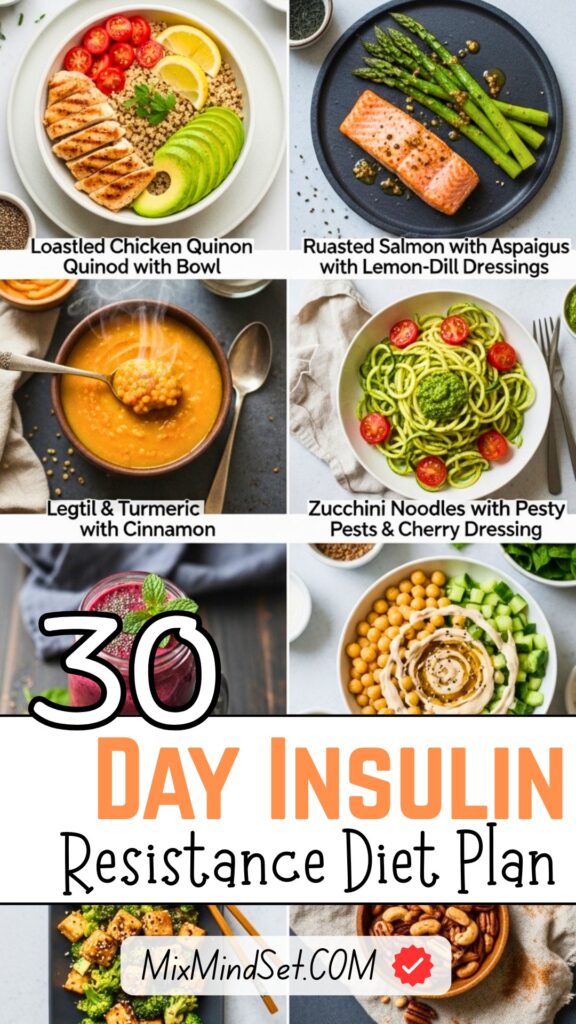
30 Day Insulin Resistance Diet Plan
Think of insulin as a key that unlocks your cells to let blood sugar (glucose) in for energy. In insulin resistance, the locks are rusted. Your cells don’t respond well to insulin, so your pancreas works overtime, pumping out more and more insulin to get the job done.
Over time, this leads to:
- High blood sugar and eventually prediabetes or type 2 diabetes
- Stubborn weight gain, especially around the belly
- Constant cravings and energy crashes
- Hormonal issues like PCOS
The goal of this 30-day plan isn’t deprivation. It’s resensitising your body with whole foods, smart meal timing, and a specific order of eating.
Key fact: A 30-day plan focusing on fiber, protein, timing, order of eating, and movement has been shown to improve insulin sensitivity and help reverse metabolic issues.
The 5 Core Rules of This 30-Day Plan
Before you plan a single meal, adopt these five foundational habits. They matter more than any single “superfood.”
1. Focus on a High-Protein, High-Fiber Foundation
Each meal should provide at least 20-30g of protein and 5-8g of fiber. Fiber slows down the absorption of sugar into your bloodstream, protecting you from spikes.
Aim for:
- Protein: 90g+ per day (across 3 meals and 1-2 snacks)
- Fiber: 30g+ per day
This combination significantly reduces cravings and supports steady energy.
2. Eat Your Food in the Right Order (This Is Crucial)
This is one of the most powerful and easiest habits you can adopt:
- Non-starchy vegetables first (fiber)
- Protein next (meat, eggs, tofu, beans)
- Fats alongside protein
- Carbohydrates last
Eating vegetables and protein before carbohydrates has been shown to significantly reduce post-meal glucose spikes. Healthy fats paired with protein 10-15 minutes before carbs can also trigger hormones that improve insulin sensitivity and keep you full longer.
3. Time Your Meals Evenly
Allow no more than 4-5 hours between eating occasions to maintain stable blood sugar. Spacing your meals evenly supports muscle health and improves insulin sensitivity. Skipping meals, especially breakfast, can shift glucose control in an unfavorable direction.
4. Keep Moving Daily
Exercise makes your cells more sensitive to insulin. You don’t need to run marathons. A 15-20 minute walk after meals using your largest muscles (legs and glutes) is one of the most effective ways to clear glucose from your bloodstream.
5. Quit the Added Sugars and Refined Carbs
Avoid soda, fruit juice, white bread, white rice, sugary cereals, pastries, and anything with added sugar.
Your Insulin Resistance Food Guide: Eat This, Not That
Best Foods for Insulin Sensitivity (Eat Freely)
| Category | Best Choices |
|---|---|
| Non-starchy vegetables | Spinach, kale, broccoli, cauliflower, zucchini, bell peppers, cucumber, celery, asparagus, green beans |
| Lean proteins | Chicken breast, turkey, fish (salmon, cod, tuna), eggs, tofu, edamame, lentils, chickpeas, Greek yogurt |
| Healthy fats | Avocado, olive oil, nuts (almonds, walnuts), seeds (chia, flax, pumpkin), nut butters |
| Low-sugar fruits | Berries (blueberries, strawberries, raspberries), green apples, oranges, kiwi |
| Whole grains (in moderation) | Oats, quinoa, brown rice, barley, farro |
| Legumes | lentils, chickpeas, black beans, kidney beans |
Foods to Avoid or Strictly Limit (Especially in Weeks 1-2)
| Category | Avoid These |
|---|---|
| Sugary drinks | Soda, sweet tea, fruit juice, energy drinks, sweetened coffee drinks |
| Refined carbs | White bread, white rice, white pasta, regular crackers, most cereals |
| Added sugars | Candy, cookies, cake, ice cream, sweetened yogurt, honey, maple syrup (in large amounts) |
| Processed snacks | Chips, pretzels, sugary granola bars |
| Fried foods | French fries, fried chicken, onion rings |
30-Day Insulin Resistance Meal Plan: Weeks 1-4
This 30-day plan is set at a baseline of approximately 1,500 calories, with modifications for 1,200 and 1,800 calories depending on your needs. Each day provides at least 90g of protein and 34g of fiber.
Week 1: Foundation
Focus on establishing the 5 core rules: protein + fiber at every meal, eating food in the right order, moving after eating, and cutting out added sugars.
Day 1 (Monday)
- Breakfast: 3 egg white & spinach scramble + 1 slice whole wheat toast + ½ grapefruit
- Lunch: Large salad (mixed greens, cucumber, bell pepper, 4 oz grilled chicken, 2 tbsp hummus, olive oil dressing)
- Dinner: 5 oz baked cod + 1 cup roasted asparagus + ½ cup quinoa
- Snack: 10 almonds + 5 strawberries
Day 2 (Tuesday)
- Breakfast: ½ cup plain Greek yogurt + ½ cup blueberries + 1 tbsp chia seeds
- Lunch: 4 oz sliced turkey + ¼ avocado rolled in lettuce leaves + small apple
- Dinner: 4 oz lean turkey burger (no bun) over mixed greens + roasted sweet potato wedges
- Snack: 1 hard-boiled egg + 6 baby carrots
Day 3 (Wednesday)
- Breakfast: Vanilla protein shake (1 scoop) + 1 tbsp peanut butter + ½ banana + unsweetened almond milk
- Lunch: Leftover turkey burger salad
- Dinner: 5 oz salmon + 1 cup Brussels sprouts + ½ cup brown rice
- Snack: ½ cup low-fat cottage cheese + cucumber slices
Day 4 (Thursday)
- Breakfast: 2 poached eggs + ½ avocado on 1 slice whole grain toast
- Lunch: Lentil & vegetable soup (1.5 cups) + side salad
- Dinner: 4 oz chicken stir-fry (broccoli, snap peas, carrots, ginger, tamari) + ½ cup brown rice
- Snack: 1 string cheese + 5 whole grain crackers
Day 5 (Friday)
- Breakfast: Chia seed pudding (3 tbsp chia + 1 cup almond milk) + ½ cup raspberries
- Lunch: Leftover chicken stir-fry
- Dinner: 5 oz baked cod + 1 cup green beans + quinoa
- Snack: Small handful of walnuts + 1 orange
Day 6 (Saturday)
- Breakfast: Tofu scramble (½ block firm tofu, turmeric, spinach, bell peppers) + 1 slice whole grain toast
- Lunch: Black bean & corn bowl (½ cup black beans, corn, diced avocado, salsa) + side of baked tortilla chips (2 oz)
- Dinner: 4 oz grilled shrimp skewers + 1 cup grilled zucchini + ½ cup farro
- Snack: Apple slices + 1 tbsp almond butter
Day 7 (Sunday)
- Breakfast: Oatmeal (½ cup rolled oats cooked with skim milk, 1 tbsp chopped walnuts, 1 tsp cinnamon, ½ banana)
- Lunch: Leftover shrimp + zucchini
- Dinner: 4 oz roast chicken + 1 cup steamed broccoli + ½ cup sweet potato
- Snack: ½ cup Greek yogurt + ¼ cup mixed berries
*Each week follows a similar pattern. Below is a sample of days 8-10 to illustrate progression.*
Week 2: Consistent
You’re now in the groove. Focus on meal prep to make this sustainable.
Day 8 (Monday)
- Breakfast: 2 egg & mushroom omelette + 1 slice whole wheat toast
- Lunch: Quinoa tabbouleh (1 cup quinoa, parsley, mint, cucumber, tomato, lemon, 1 tbsp olive oil) + 4 oz grilled chicken
- Dinner: 5 oz baked salmon + 1 cup roasted Brussels sprouts + ½ cup brown rice
- Snack: Handful of almonds + 5 strawberries
Day 9 (Tuesday)
- Breakfast: Protein smoothie (vanilla protein, spinach, ½ banana, 1 tbsp flaxseed, almond milk)
- Lunch: Leftover quinoa + chicken
- Dinner: 4 oz turkey & black bean chili (no beans for lower carb option) over cauliflower rice
- Snack: 1 hard-boiled egg + 6 baby carrots
Day 10 (Wednesday)
- Breakfast: ½ cup Greek yogurt + ¼ cup low-sugar granola + ½ cup blueberries
- Lunch: Tuna salad lettuce wraps (1 can tuna + Greek yogurt + celery + 2 tbsp hummus) + small apple
- Dinner: 4 oz chicken + bell pepper + onion skewers (grilled) + ½ cup quinoa
- Snack: 1 string cheese + 5 whole grain crackers
Meal Prep & Shopping Tips For The Full 30 Days
To make the entire 30 days easier, batch-cook on Sunday:
- Proteins: Bake 4-6 chicken breasts, hard-boil 6 eggs, cook 1 lb lean ground turkey.
- Grains: Make 2 cups dry quinoa (≈4 cups cooked) and 2 cups dry brown rice (≈6 cups cooked).
- Vegetables: Wash and chop greens, bell peppers, cucumbers, and carrots. Roast 2 trays of mixed vegetables (broccoli, cauliflower, Brussels sprouts).
- Sauces/dressings: Make a large batch of lemon-tahini or olive oil + vinegar dressing.
- Breakfasts: Portion out overnight oats or chia pudding in jars.
3 Complete Insulin Resistance Recipes (Numbered)
Recipe 1: High-Protein Blueberry-Peanut Butter Chia Pudding
Perfect for meal prep. This pudding provides steady energy without a glucose spike.
Ingredients:
| Ingredient | Amount | Protein |
|---|---|---|
| Chia seeds | 3 tbsp | 5g |
| Unsweetened almond milk | 1 cup | 1g |
| Plain Greek yogurt | ¼ cup | 6g |
| Vanilla protein powder | 1 scoop (30g) | 20g |
| Natural peanut butter | 1 tbsp | 4g |
| Fresh or frozen blueberries | ½ cup | 0.5g |
| Cinnamon | ¼ tsp | 0g |
| Total Protein | ~36.5g |
Instructions:
- In a large jar or bowl, combine chia seeds, almond milk, Greek yogurt, protein powder, peanut butter, and cinnamon. Whisk thoroughly to break up any clumps.
- Gently fold in blueberries.
- Cover and refrigerate for at least 4 hours, preferably overnight.
- Serve cold. Top with extra blueberries and a sprinkle of chia seeds if desired.
Nutritional Facts (per serving):
| Nutrient | Amount |
|---|---|
| Calories | 580 |
| Protein | 36g |
| Carbohydrates | 36g |
| Fiber | 16g |
| Sugar | 12g (natural) |
| Fat | 33g |
Recipe 2: Savory Oatmeal Grain Bowl
Oatmeal doesn’t have to be sweet. This savory version is packed with protein and fiber.
Ingredients:
| Ingredient | Amount | Protein |
|---|---|---|
| Rolled oats | ½ cup | 5g |
| Water or low-sodium broth | 1 cup | 1-2g |
| Large egg | 1 | 6g |
| Fresh spinach | 1 cup | 1g |
| Avocado | ¼ medium | 1g |
| Nutritional yeast | 1 tbsp | 3g |
| Everything bagel seasoning or black pepper | To taste | 0g |
| Total Protein | ~17g |
Instructions:
- Cook oats in water or broth according to package directions (about 5 minutes).
- While oats cook, poach or fry an egg in a separate pan.
- Stir spinach into hot oats until wilted.
- Transfer oats to a bowl. Top with the egg, avocado slices, and nutritional yeast.
- Season with everything bagel seasoning or black pepper.
Nutritional Facts (per serving):
| Nutrient | Amount |
|---|---|
| Calories | 470 |
| Protein | 17g |
| Carbohydrates | 45g |
| Fiber | 11g |
| Sugar | 2g |
| Fat | 25g |
Recipe 3: Southwest Turkey Meatloaf
Meal prep friendly and delicious. Freezes well.
Ingredients (makes 4 servings):
| Ingredient | Amount | Protein |
|---|---|---|
| Lean ground turkey (93% lean) | 1 lb | 80g |
| Black beans (rinsed) | ½ cup | 7g |
| Frozen corn | ½ cup | 3g |
| Diced bell pepper | ½ cup | 0.5g |
| Salsa (no sugar added) | ¼ cup | 1g |
| Egg | 1 | 6g |
| Almond flour | ¼ cup | 6g |
| Cumin, chili powder, garlic powder | 1 tsp each | 0g |
| Total Protein | ~103g | |
| Per serving | ~26g |
Instructions:
- Preheat oven to 375°F (190°C). Line a loaf pan with parchment paper.
- In a large bowl, combine ground turkey, black beans, corn, bell pepper, salsa, egg, almond flour, and spices. Mix gently with your hands until just combined (do not overmix).
- Press mixture into the prepared loaf pan.
- Bake for 45-50 minutes until internal temperature reaches 165°F (74°C).
- Let rest for 10 minutes before slicing. Serve with a side of roasted vegetables.
Nutritional Facts (per serving – ¼ of loaf):
| Nutrient | Amount |
|---|---|
| Calories | 340 |
| Protein | 26g |
| Carbohydrates | 19g |
| Fiber | 6g |
| Sugar | 4g |
| Fat | 18g |
5 Common Mistakes on an Insulin Resistance Diet
1. Eating “healthy” carbs without protein or fat.
Even whole-grain bread or brown rice can spike your blood sugar if eaten alone.
Solution: Always pair carbohydrates with protein and healthy fat. An apple alone is not ideal; apple with peanut butter is good.
2. Snacking on low-protein, high-carb foods.
Crackers, pretzels, granola bars, and dried fruit can keep insulin elevated all day.
Solution: Choose snacks that combine protein, fat, and fiber: nuts, hard-boiled eggs, Greek yogurt, veggies with hummus.
3. Eating too late at night.
Large meals close to bedtime disrupt glucose regulation overnight.
Solution: Finish dinner at least 2-3 hours before bed. If you need an evening snack, keep it small and protein-based (½ cup Greek yogurt).
4. Giving up after one high-carb meal.
Had a slice of pizza at a party? One meal won’t ruin your progress.
Solution: Get right back on track with your next meal. Guilt is not productive.
5. Not prioritizing sleep.
Poor sleep directly increases insulin resistance.
Solution: Prioritize 7-8 hours of quality sleep.
Frequently Asked Questions
How long until I see results from this 30-day plan?
Many people notice reduced cravings and more stable energy within 5-7 days. Blood sugar improvements can be seen within 2-3 weeks. For significant changes in insulin sensitivity, stick with the plan for the full 30 days and beyond.
Can I have coffee on this plan?
Yes, black coffee or with a splash of unsweetened almond milk is fine. Avoid sugary creamers, syrups, and large amounts of dairy cream.
Will this plan help me lose weight?
Yes, indirectly. By stabilising your blood sugar and reducing insulin levels, your body becomes more able to access stored fat for energy. Many people lose 5-10 pounds over 30 days without extreme calorie restriction.
What about intermittent fasting?
Intermittent fasting can be helpful for some people with insulin resistance, but it’s not required. If you want to try it, start with a 12-hour overnight fast (e.g., finish dinner at 7pm, eat breakfast at 7am). Avoid skipping breakfast entirely if you have blood sugar issues.
Do I need to count calories?
Not strictly. Focus on food quality, the 5 core rules, and portion sizes. If weight loss stalls, you may need to pay closer attention to portions of calorie-dense foods like nuts, avocado, and oil.
Is this plan safe for type 2 diabetes?
Yes, most of this plan is appropriate for type 2 diabetes. However, if you take medications (especially insulin or sulfonylureas), consult your doctor before starting as your medication may need adjustment.
What if I don’t like fish?
You don’t need to eat fish. Get omega-3s from walnuts, flaxseeds, and chia seeds. Get protein from chicken, turkey, eggs, tofu, and beans.
Your Action Plan: The First 3 Days
- Day 1: Start each meal with non-starchy vegetables before eating protein or carbs.
- Day 2: Add a 15-minute walk after dinner.
- Day 3: Swap your usual breakfast for a high-protein option (eggs, Greek yogurt, or a protein shake).
These three small changes will create momentum for the full 30 days.
Final Thoughts
Insulin resistance develops over years of processed food. You won’t reverse it in a week. But 30 days of consistent, whole-food eating can dramatically shift your metabolic health. You’ll learn which foods make you feel good and which ones spike your cravings.
Don’t expect perfection through the entire month. Expect progress. The goal isn’t to follow this plan rigidly for 30 days and then go back to old habits. The goal is to discover a way of eating that feels sustainable long-term.
Your body is always listening. Start giving it the signals it needs to heal.
Disclaimer: This article is for informational purposes only and does not constitute medical advice. If you have diabetes, PCOS, or other medical conditions, consult your healthcare provider before starting this plan. Do not stop or adjust medications without medical supervision.