How to Use Chopsticks: A Simple Beginner’s Guide to Eating With Confidence
Using chopsticks can feel awkward at first, especially if you did not grow up with them. The good news is that it is a skill almost anyone can learn with a little practice. Once you understand the basic grip and movement, chopsticks start to feel much more natural.
This guide explains how to use chopsticks in a simple, practical way. You will learn the correct hand position, easy practice tips, common mistakes to avoid, and a few helpful etiquette basics.
Whether you want to enjoy sushi, noodles, dumplings, or rice dishes more comfortably, this step-by-step guide will help you get started.
Why Learning to Use Chopsticks Is Worth It?
Chopsticks are used across many Asian cuisines and dining traditions. Learning to use them is not just about technique. It can also make meals more enjoyable and help you feel more comfortable when eating in restaurants or with friends.
A few benefits of learning this skill include:
- Better control when picking up small foods
- A more authentic dining experience for many dishes
- Improved hand coordination
- More confidence in social dining situations
At first, your fingers may feel stiff or clumsy. That is completely normal. Most beginners improve quickly once they stop squeezing too hard and focus on the right movement.
Table of Contents
How to Hold Chopsticks Correctly?
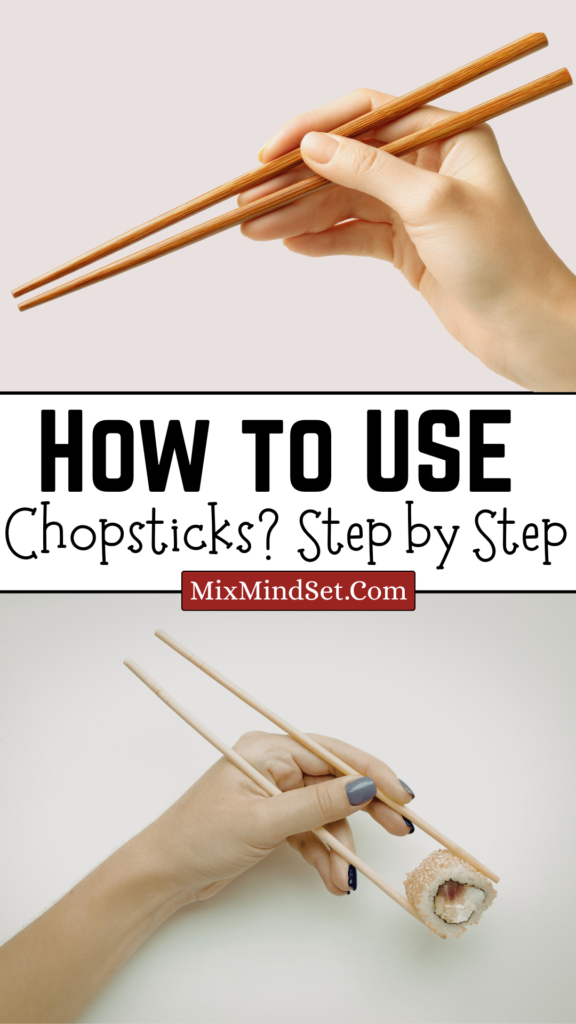
The biggest secret is this: only the top chopstick should move. The bottom chopstick stays mostly still and acts like a base.
Step-by-Step Chopstick Grip
Follow these steps slowly and adjust your fingers until the grip feels steady.
- Place the first chopstick in the curve between your thumb and index finger.
- Let the lower part of that chopstick rest lightly on your ring finger.
- Keep this bottom chopstick steady. It should not move much.
- Hold the second chopstick like a pencil, using your thumb, index finger, and middle finger.
- Move only the top chopstick up and down.
- Practice opening and closing the tips until they meet neatly.
Video Guide 📺
Quick Position Guide
| Part | What It Does | Where It Rests |
|---|---|---|
| Bottom chopstick | Stays still and supports food | Between thumb base and ring finger |
| Top chopstick | Moves to grip food | Held by thumb, index, and middle finger |
| Thumb | Helps stabilize both chopsticks | Presses gently from the side |
| Ring finger | Supports the bottom chopstick | Under the lower stick |
| Index and middle fingers | Control movement of the top chopstick | On the upper stick |
A good grip should feel firm but relaxed. If your hand starts to cramp, you are probably holding the chopsticks too tightly.
How to Use Chopsticks to Pick Up Food?
Once your grip feels comfortable, the next step is learning how to actually pick up food. Start with items that are easy to grab before trying slippery noodles or tiny pieces of food.
Best Foods to Practice With
These are beginner-friendly foods because they are easier to control:
- Bread cubes
- Cucumber slices
- Large pasta pieces
- Dumplings
- Marshmallows
- Apple chunks
After that, you can move on to more difficult foods like:
- Peanuts
- Beans
- Noodles
- Rice from a bowl
- Small vegetable pieces
Basic Motion to Remember
When using chopsticks, think of the motion as a gentle pinch, not a stab or squeeze.
Here is the basic process:
- Open the top chopstick slightly.
- Position the tips around the food.
- Close the top chopstick gently against the bottom one.
- Lift slowly and keep your hand steady.
- Bring the food to your mouth without rushing.
Try to keep the chopstick tips aligned. If the ends cross over each other, it becomes much harder to grip food properly.
Easy Tips to Learn Faster:
Learning chopsticks is easier when you practice in a simple and patient way. Small adjustments often make a big difference.
Practical Tips for Beginners
- Start with thicker chopsticks if possible. They are often easier to control.
- Practice with dry foods before slippery foods.
- Hold the chopsticks farther back rather than too close to the tips.
- Relax your fingers and wrist.
- Practice for a few minutes at a time instead of forcing long sessions.
Simple Home Practice Idea
You can improve quickly with this easy routine:
| Practice Item | Difficulty Level | What It Helps With |
|---|---|---|
| Marshmallows | Very easy | Learning the pinch motion |
| Bread cubes | Easy | Building control |
| Grapes | Easy to medium | Improving grip strength |
| Peanuts | Medium | Precision |
| Noodles | Hard | Coordination and patience |
Even 5 to 10 minutes of practice can help your fingers remember the movement.
Common Chopstick Mistakes to Avoid:
Many beginners struggle for the same reasons. Fixing these small mistakes can make chopsticks feel much easier almost immediately.
Mistakes That Make Chopsticks Harder to Use
- Holding both chopsticks like they should both move
- Gripping too tightly
- Holding them too close to the tips
- Letting the chopstick ends cross
- Trying difficult foods too early
- Moving the whole hand instead of just the top stick
What to Do Instead
If you notice these problems, try these corrections:
- Keep the bottom chopstick still.
- Loosen your grip slightly.
- Re-align the chopstick tips so they meet evenly.
- Slow down and practice with larger food pieces.
- Check that your middle finger is helping move the top chopstick.
A relaxed hand usually performs better than a tense one.
Basic Chopstick Etiquette to Know
If you are using chopsticks in a restaurant or at someone’s table, a little etiquette can help you feel more confident. Exact customs vary by country and setting, but a few general rules are widely helpful.
Good Chopstick Manners
- Rest chopsticks neatly when not using them
- Use the serving utensil if one is provided
- Pick up food politely without waving chopsticks around
- Hold your bowl close when appropriate for the meal
Things to Avoid
- Do not point at people with chopsticks
- Do not stab food like a fork
- Do not rub disposable chopsticks together in a formal setting
- Do not leave chopsticks standing upright in rice
- Do not play with chopsticks at the table
These habits are not only practical, they also show respect for the meal and the people around you.
Frequently Asked Questions
Is it hard to learn how to use chopsticks?
It can feel tricky in the beginning, but most people can learn the basics with regular practice. The main thing is to understand that only the top chopstick moves.
How long does it take to get good at using chopsticks?
That depends on how often you practice. Many beginners feel more comfortable after a few short sessions. Real confidence usually comes with repeated use during actual meals.
Can I eat rice with chopsticks?
Yes, but the method depends on the type of rice. Sticky rice is easier to pick up. Loose rice is often eaten by lifting the bowl closer and guiding the rice into the mouth carefully.
What kind of chopsticks are best for beginners?
Beginners often do well with chopsticks that are slightly textured, not too slippery, and a little thicker. Wooden or bamboo chopsticks are usually easier to control than very smooth metal ones.
Why do my fingers hurt when I use chopsticks?
This usually happens because you are gripping too tightly or using too much force. Try relaxing your hand and checking your finger placement.
Can children learn to use chopsticks too?
Yes, many children can learn with practice. Training chopsticks or beginner-friendly designs can make the process easier.
Final Thoughts
Learning how to use chopsticks is one of those small skills that becomes easier the moment you understand the basic movement. You do not need perfect technique right away. Focus on holding them properly, keeping the bottom stick still, and practicing with easy foods first.
With a bit of patience, chopsticks can go from frustrating to natural. The key is to stay relaxed, practice often, and let your fingers build confidence over time. Once it clicks, you will likely wonder why it ever felt difficult in the first place.