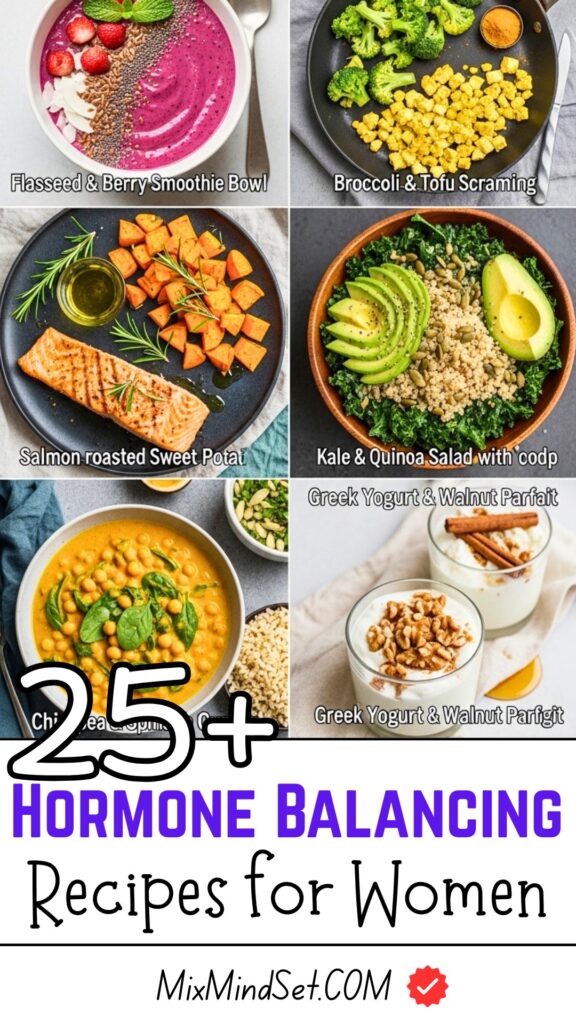
25+ Hormone Balancing Recipes for Women
Do you wake up tired even after eight hours of sleep? Feel unexplained mood swings before your period? Struggle with stubborn weight gain around your midsection? These are often signs that your hormones need support.
Hormones are your body’s chemical messengers. They control everything from your menstrual cycle and fertility to your metabolism, mood, and sleep. When they’re out of balance — whether from stress, diet, perimenopause, or conditions like PCOS — you feel it everywhere.
The good news is that food is one of the most powerful tools for hormone harmony. Certain nutrients help your liver clear excess estrogen, stabilize blood sugar (which directly impacts insulin and cortisol), and provide the building blocks for progesterone and thyroid hormones.
This guide gives you over 25 delicious, practical recipes designed specifically for women’s hormonal health. Each idea focuses on whole foods that work with your body, not against it.
Table of Contents
Why Your Diet Directly Impacts Your Hormones?
Your hormones don’t exist in a vacuum. They’re made from the food you eat, broken down by your liver, and influenced by your gut bacteria. Here’s how diet plays a starring role:
- Blood sugar balance – When you eat refined carbs and sugar, insulin spikes. Over time, high insulin disrupts estrogen, progesterone, and testosterone. This is a root cause of PCOS, perimenopausal symptoms, and weight gain.
- Liver detoxification – Your liver processes used hormones (especially estrogen) for elimination. Cruciferous vegetables like broccoli and kale support this detox pathway.
- Gut health – Your gut microbiome helps recycle or excrete estrogen. Constipation can lead to estrogen reabsorption, worsening imbalances.
- Healthy fats – Your body needs cholesterol and omega-3 fatty acids to produce all steroid hormones, including estrogen, progesterone, cortisol, and vitamin D.
Key takeaway: A hormone-balancing diet is rich in fiber, healthy fats, lean protein, and anti-inflammatory compounds — while being low in sugar, processed foods, and industrial seed oils.
Top Hormone-Supporting Foods (Quick Reference Table)
| Nutrient / Food | Why It Helps | Best Sources |
|---|---|---|
| Cruciferous vegetables | Support liver detox of excess estrogen | Broccoli, cauliflower, kale, Brussels sprouts, cabbage |
| Flaxseeds | Lignans bind to excess estrogen; fiber supports elimination | Ground flaxseeds (1-2 tbsp daily) |
| Omega-3 fatty acids | Reduce inflammation; support cell membrane health | Wild salmon, sardines, walnuts, chia seeds, flaxseeds |
| Magnesium | Calms stress (cortisol); supports sleep and PMS | Pumpkin seeds, almonds, spinach, dark chocolate |
| Vitamin B6 | Helps progesterone production; reduces PMS symptoms | Chickpeas, poultry, bananas, potatoes |
| Zinc | Supports ovulation and thyroid function | Oysters, beef, pumpkin seeds, lentils |
| Fiber | Removes used estrogen through stool | Berries, beans, oats, apples, psyllium |
| Probiotic foods | Improves gut microbiome for estrogen metabolism | Yogurt (dairy or coconut), kefir, sauerkraut, kimchi |
| Adaptogenic herbs | Helps balance cortisol and stress response | Ashwagandha, maca, rhodiola (use as directed) |
25+ Hormone Balancing Recipe Ideas (By Meal)
Breakfast Ideas (6 Ideas)
Start your day with protein, fiber, and healthy fats to stabilize blood sugar from the morning.
- Flaxseed & Berry Smoothie – 1 tbsp ground flaxseed, ½ cup frozen berries, 1 scoop collagen or pea protein, unsweetened almond milk, handful spinach.
- Broccoli & Egg Scramble – Sauté chopped broccoli, then add 2 eggs and a sprinkle of turmeric. Serve with half an avocado.
- Pumpkin Seed Oatmeal – Cooked oats topped with 1 tbsp pumpkin seeds, cinnamon, and sliced banana.
- Chia Pudding – 3 tbsp chia seeds + 1 cup coconut milk + ½ tsp vanilla. Top with raspberries and walnuts.
- Savory Millet Bowl – Cooked millet with sautéed kale, a poached egg, and a drizzle of tahini.
- Sweet Potato Toast – Thinly sliced sweet potato toasted, topped with almond butter and hemp seeds.
Lunch Ideas (7 Ideas)
Keep lunches balanced with leafy greens, lean protein, and healthy fats.
- Kale & Quinoa Salad – Massaged kale, cooked quinoa, roasted chickpeas, shredded carrots, lemon-tahini dressing.
- Leftover Salmon Salad – Canned wild salmon mixed with avocado and lemon, served on mixed greens.
- Broccoli & Cheddar Soup (dairy-free) – Blended steamed broccoli with coconut milk and nutritional yeast.
- Turkey & Avocado Wrap – Use a large collard green leaf instead of tortilla. Fill with sliced turkey, avocado, shredded cabbage.
- Lentil & Roasted Vegetable Bowl – Brown lentils, roasted cauliflower and sweet potato, dollop of hummus.
- Sardine Toast – Mashed sardines on gluten-free or sourdough toast with a squeeze of lemon and fresh dill.
- Leftover Stir-Fry – Tofu or chicken with broccoli, bok choy, and a ginger-tamari sauce over brown rice.
Dinner Ideas (7 Ideas)
Evening meals should be satisfying but not too heavy. Include a cruciferous vegetable most nights.
- Baked Salmon with Roasted Brussels Sprouts – 5 oz salmon, halved Brussels sprouts tossed in olive oil, bake at 400°F for 15 min.
- Turkey & Cabbage Stir-Fry – Ground turkey, shredded cabbage, carrots, ginger, garlic, coconut aminos.
- Lentil & Kale Shepherd’s Pie – Lentil-mushroom filling topped with mashed cauliflower and sweet potato.
- Chicken & Broccoli Casserole – Use coconut milk and nutritional yeast for a creamy, dairy-free sauce.
- Beef & Broccoli (low-sugar) – Thinly sliced grass-fed beef, broccoli florets, tamari, ginger, sesame oil.
- Cauliflower Fried Rice – Riced cauliflower stir-fried with eggs, peas, carrots, and shrimp or tofu.
- Stuffed Bell Peppers – Filled with ground turkey, black beans, corn, and topped with avocado.
Snack Ideas (5 Ideas)
Smart snacks prevent blood sugar crashes that trigger cortisol and cravings.
- Handful of almonds + a few squares of dark chocolate (70%+ cocoa)
- Apple slices with 1 tbsp almond butter
- Hard-boiled egg sprinkled with sea salt and paprika
- Cucumber rounds topped with tuna salad
- Roasted chickpeas (toss canned chickpeas with olive oil and curry powder, bake at 400°F for 20 min)
Drinks & Tonics (3 Ideas)
What you drink matters as much as what you eat.
- Golden Milk – Warm unsweetened almond milk + 1 tsp turmeric + ¼ tsp black pepper + 1 tsp coconut oil + a dash of cinnamon.
- Red Raspberry Leaf Tea – Supports uterine health and PMS. Steep 1 tbsp dried leaves in hot water for 10 minutes.
- Lemon Ginger Liver Tonic – Warm water with juice of ½ lemon, 1 inch grated ginger, and a pinch of cayenne.
3 Featured Hormone Balancing Recipes (With Full Nutritional Facts)
Recipe 1: Flaxseed & Berry Hormone Smoothie
Ground flaxseeds provide lignans that help balance estrogen. Berries add antioxidants and fiber.
Ingredients:
| Ingredient | Amount |
|---|---|
| Ground flaxseed | 1 tbsp |
| Frozen mixed berries (blueberries, raspberries) | ½ cup |
| Unsweetened almond milk | 1 cup |
| Handful fresh spinach | 1 cup |
| Vanilla protein powder (pea or collagen) | 1 scoop (optional) |
| Cinnamon | ¼ tsp |
Instructions:
- Add all ingredients to a blender.
- Blend on high until smooth (about 30 seconds).
- Pour into a glass and drink immediately.
Nutritional Facts (per serving, without protein powder):
| Nutrient | Amount |
|---|---|
| Calories | 180 |
| Protein | 6g |
| Carbohydrates | 20g |
| Fiber | 9g |
| Fat | 9g |
| Omega-3s | ~2.2g (from flax) |
| Magnesium | 15% DV |
Recipe 2: Broccoli & Egg Hormone Support Scramble
Broccoli is a cruciferous powerhouse that supports liver detox of excess estrogen. Eggs provide B vitamins and protein.
Ingredients:
| Ingredient | Amount |
|---|---|
| Fresh broccoli florets | 1 cup |
| Eggs (pasture-raised if possible) | 2 large |
| Avocado | ½ medium |
| Turmeric powder | ¼ tsp |
| Black pepper | Pinch |
| Olive oil or coconut oil | 1 tsp |
| Sea salt | To taste |
Instructions:
- Chop broccoli into small bite-sized pieces.
- Heat oil in a non-stick pan over medium heat. Add broccoli and sauté for 3-4 minutes until bright green and slightly tender.
- In a small bowl, whisk eggs with turmeric, black pepper, and salt.
- Pour eggs over broccoli. Stir gently with a spatula until eggs are just set (about 2 minutes).
- Serve immediately with half an avocado on the side.
Nutritional Facts (per serving):
| Nutrient | Amount |
|---|---|
| Calories | 380 |
| Protein | 18g |
| Carbohydrates | 12g |
| Fiber | 7g |
| Fat | 30g (mostly unsaturated) |
| Vitamin K | 150% DV |
| Folate | 40% DV |
| Choline (for liver) | 35% DV |
Recipe 3: Golden Milk Turmeric Latte
This anti-inflammatory drink lowers cortisol, supports liver function, and aids sleep when consumed in the evening.
Ingredients:
| Ingredient | Amount |
|---|---|
| Unsweetened almond milk (or coconut milk) | 1 cup |
| Ground turmeric | 1 tsp |
| Ground ginger (or ½ inch fresh) | ½ tsp |
| Cinnamon | ¼ tsp |
| Black pepper | A pinch (critical for turmeric absorption) |
| Coconut oil or MCT oil | 1 tsp |
| Raw honey or maple syrup (optional) | 1 tsp |
Instructions:
- In a small saucepan, warm almond milk over medium-low heat (do not boil).
- Whisk in turmeric, ginger, cinnamon, black pepper, and coconut oil until fully combined and frothy.
- Add sweetener if desired. Pour into a mug and enjoy warm.
Nutritional Facts (per serving, without sweetener):
| Nutrient | Amount |
|---|---|
| Calories | 110 |
| Protein | 1g |
| Carbohydrates | 3g |
| Fiber | 1g |
| Fat | 10g |
| Curcumin (from turmeric) | ~100 mg |
Note: Black pepper increases curcumin absorption by 2000%
5 Common Mistakes Women Make When Trying to Balance Hormones
1. Eating too little fat.
Your body needs dietary fat to produce hormones. Low-fat diets can worsen PMS and menopausal symptoms. Solution: Include a serving of healthy fat (avocado, nuts, olive oil, fatty fish) at every meal.
2. Relying on soy isolates and processed “vegan” foods.
Whole soy (tofu, tempeh, edamame) is fine for most women. But highly processed soy protein isolates and fake meats often contain additives that disrupt hormones. Solution: Stick to whole food sources of soy.
3. Ignoring blood sugar spikes.
Even “healthy” foods like oatmeal with honey can spike blood sugar if eaten without protein or fat. Solution: Pair carbs with protein and fat. Example: oats + nuts + egg whites.
4. Over-exercising or under-eating.
Chronic caloric restriction and high-intensity exercise without recovery raise cortisol, which disrupts all other hormones. Solution: Prioritize rest days and eat enough to support your activity level.
5. Expecting overnight results.
Hormones respond slowly to dietary changes. It can take 3 full menstrual cycles (about 12 weeks) to see consistent improvements in PMS, cycle regularity, or perimenopausal symptoms. Solution: Be patient and consistent.
Frequently Asked Questions
Can these recipes help with perimenopause symptoms?
Yes. Perimenopause involves fluctuating estrogen and progesterone. Foods that support liver detox (cruciferous vegetables) and provide healthy fats (omega-3s) can reduce hot flashes, night sweats, and mood swings. Flaxseeds and phytoestrogens (like tofu) may also help.
What about PCOS? Are these recipes safe?
Absolutely. PCOS is driven by insulin resistance and high androgens. The recipes here emphasize low-glycemic carbs, high fiber, and lean protein — exactly what PCOS management requires. Avoid added sugars and refined carbs.
Do I need to avoid dairy and gluten?
Not necessarily. Some women find that dairy or gluten worsens hormonal acne or bloating. But there’s no universal rule. Try eliminating one at a time for 3-4 weeks to see how you feel. The recipes above are mostly dairy-free and gluten-free by design.
How much flaxseed should I eat daily?
1 to 2 tablespoons of ground flaxseed per day is optimal for hormone balance. Whole flaxseeds pass through undigested. Always grind them fresh (a coffee grinder works) or buy pre-ground and store in the fridge.
Can men eat these recipes?
Yes, all of these recipes are healthy for anyone. However, men with estrogen-sensitive conditions (like prostate issues) should not overdo phytoestrogen-rich foods like flax or soy. For most men, moderate amounts are fine.
When is the best time to drink Golden Milk?
Evening, about 30-60 minutes before bed. The combination of turmeric, ginger, and healthy fat calms the nervous system and supports deep sleep. Avoid drinking it right after a heavy meal.
Your Simple 3-Day Hormone Balancing Meal Plan
Day 1
- Breakfast: Flaxseed & berry smoothie
- Lunch: Kale & quinoa salad with roasted chickpeas
- Dinner: Baked salmon with roasted Brussels sprouts
- Snack: Apple slices with almond butter
- Evening drink: Golden milk
Day 2
- Breakfast: Broccoli & egg scramble with half avocado
- Lunch: Leftover salmon on mixed greens
- Dinner: Turkey & cabbage stir-fry over brown rice
- Snack: Handful of almonds + dark chocolate
- Evening drink: Red raspberry leaf tea
Day 3
- Breakfast: Pumpkin seed oatmeal
- Lunch: Lentil & roasted vegetable bowl
- Dinner: Chicken & broccoli (stir-fry style) with cauliflower rice
- Snack: Hard-boiled egg
- Evening drink: Lemon ginger liver tonic (warm)
Final Thoughts: Listen to Your Body’s Signals
Hormonal symptoms — fatigue, acne, heavy periods, hot flashes, brain fog — are not “just part of being a woman.” They are signals that something needs attention. And while diet alone isn’t a magic cure, it is the foundation upon which everything else (sleep, stress management, medical care) rests.
Start with one or two recipe swaps this week. Maybe it’s the flaxseed smoothie instead of a sugary coffee drink. Or the broccoli scramble instead of a bagel. Small changes add up faster than you think.
Your hormones have been working for you since puberty. Now it’s your turn to support them.
— Fatima
Disclaimer: This article is for informational purposes only and does not constitute medical advice. If you suspect a hormonal disorder (PCOS, thyroid disease, endometriosis, etc.), please consult a healthcare provider. Do not use these recipes as a substitute for prescribed medications or treatments.