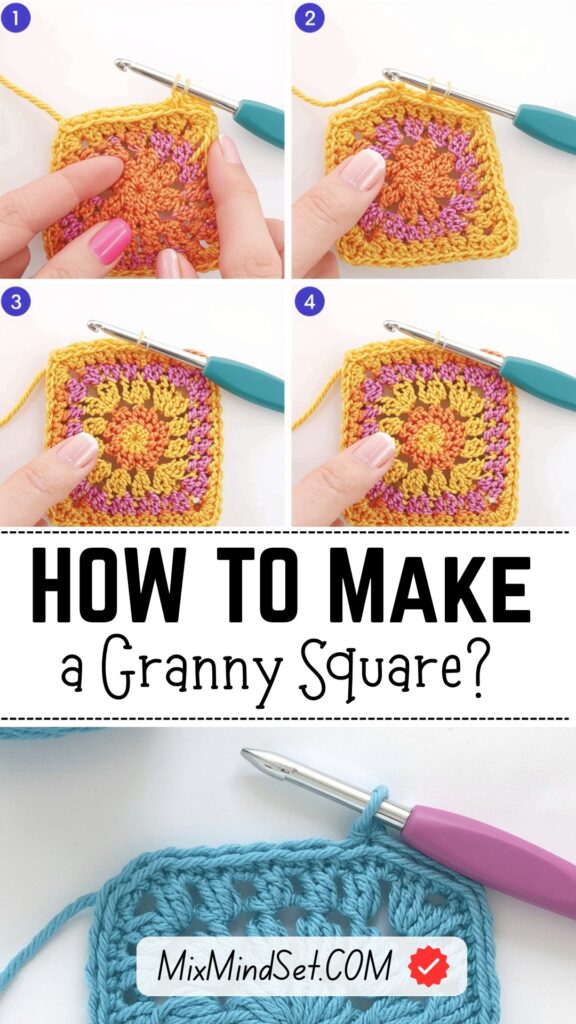
How to Make a Granny Square?
The granny square is one of the most beloved crochet patterns in the world. It is simple enough for a complete beginner, yet versatile enough for advanced makers. You can turn granny squares into blankets, bags, sweaters, pillows, and even coasters.
If you have never crocheted before, do not be intimidated. A granny square is made from just three basic stitches: chain, double crochet, and slip stitch. Once you learn the pattern, you can make a square in under 20 minutes.
This guide will walk you through every step – from choosing yarn and hook, to making the magic ring, to working the classic granny clusters, and finally joining squares together. By the end, you will be ready to create a whole blanket’s worth of these charming little squares. 🧶
Quick Navigation
1. What Is a Granny Square? (The Classic Pattern)
A granny square is a crocheted square made from groups of three double crochet stitches (called “clusters”) separated by chain spaces. The square is worked in rounds, starting from the center and growing outward. The chain spaces at the corners create the square shape.
Why granny squares are so popular:
- ✅ They use very little yarn per square – great for leftovers.
- ✅ You can make them in any size, from 2 inches to 12 inches.
- ✅ They are portable – one square at a time fits in a small bag.
- ✅ Mistakes are easy to fix (just pull back to the last round).
- ✅ The open, lacy fabric is warm but not heavy.
💡 Fun fact: Granny squares became wildly popular in the 1970s, but the pattern dates back to the 19th century. It was a way to use up tiny scraps of yarn.
2. Tools & Materials You Need
You do not need much. Here is the complete list.
| Tool | Purpose | Approx. cost |
|---|---|---|
| Crochet hook (size H/8 – 5mm or I/9 – 5.5mm) | Matches worsted weight yarn | $2–5 |
| Worsted weight yarn (medium #4) | Easy to see stitches, widely available | $4–8 per skein |
| Scissors | Cutting yarn | $1–3 |
| Yarn needle (blunt, large eye) | Weaving in ends | $2–4 |
| Stitch markers (or bobby pins) | Marking corners (helpful for beginners) | $2 or free |
Yarn tips for your first granny square:
- Choose a light, solid color (cream, light gray, pastel pink). Dark or variegated yarn makes it hard to see your stitches.
- Acrylic yarn is perfect for practice – it is cheap, forgiving, and widely available.
- One skein of worsted weight yarn (about 200–220 yards) can make 10–15 small granny squares (4 inches each).
✅ Beginner’s starter pack: One skein of light‑colored worsted yarn + one size H/8 (5mm) hook + one yarn needle. Total under $10.
3. Basic Stitches to Know Before You Start
A granny square uses only three stitches. Practice each on a small swatch first.
| Stitch | Abbreviation | What it looks like | How to make it (brief) |
|---|---|---|---|
| Chain | ch | A series of connected loops | Yarn over, pull through loop on hook. |
| Double crochet | dc | A taller stitch, about 2 chains high | Yarn over, insert hook, pull up loop, yarn over through 2 loops, yarn over through last 2 loops. |
| Slip stitch | sl st | A flat, connecting stitch | Insert hook, yarn over, pull through both hook and loop in one motion. |
Quick double crochet reminder:
- Yarn over (wrap yarn around hook from back to front).
- Insert hook into the stitch or space.
- Yarn over and pull through (3 loops on hook).
- Yarn over and pull through 2 loops (2 loops remain).
- Yarn over and pull through last 2 loops.
🧠 Memory tip: The word “double” means you yarn over twice – once at the start, and once in the middle.
Step 1 – Make the Center Ring
The granny square starts with a small ring. There are two ways to make it. Beginners should use Method A.
Method A – Chain ring (easiest for beginners)
| Step | Action |
|---|---|
| 1 | Chain 4 stitches. |
| 2 | Insert your hook into the first chain you made (the one farthest from the hook). |
| 3 | Yarn over and pull through both the chain and the loop on your hook. This is a slip stitch. |
| 4 | You now have a small ring of chains. |
Method B – Magic ring (adjustable, no hole in center): This method creates a ring that you can pull tight, leaving no gap. Search “magic ring crochet” on YouTube for a visual. It is not hard, but it helps to see it.
✅ For your first few squares, use the chain ring (Method A). It is simpler and still looks fine.
Step 2 – Round 1 (First Set of Clusters)
Now you will work into the center ring. A “cluster” is three double crochet stitches worked into the same space.
Round 1 instructions:
| Step | Action | Stitch count |
|---|---|---|
| 1 | Chain 3. (This counts as your first double crochet.) | 1 dc (the chain) |
| 2 | Work 2 more double crochet into the center ring. (Now you have 3 dc total – your first cluster.) | 3 dc |
| 3 | Chain 2. (This creates a corner space.) | – |
| 4 | Work 3 double crochet into the center ring. (Second cluster.) | 3 dc |
| 5 | Chain 2. (Corner space.) | – |
| 6 | Work 3 double crochet into the center ring. (Third cluster.) | 3 dc |
| 7 | Chain 2. (Corner space.) | – |
| 8 | Work 3 double crochet into the center ring. (Fourth cluster.) | 3 dc |
| 9 | Chain 2. (Corner space.) | – |
| 10 | Join to the top of the beginning chain 3 with a slip stitch. | – |
After Round 1, you should have:
- 4 clusters of 3 double crochet each (total 12 double crochet).
- 4 chain‑2 spaces (the corners).
- The shape is a small square.
🧩 Visualize: Think of a square with a cluster in each corner. The chain‑2 spaces are the corners themselves.
Step 3 – Round 2 (Turning the Corner)
Now you will work into the chain spaces from the previous round. The pattern repeats: clusters in the corners, and sometimes clusters along the sides.
Before starting Round 2: Slip stitch into the first chain‑2 corner space to move your hook there. (Slip stitch in each of the next 2 chains until you reach the corner space.)
Round 2 instructions:
| Step | Action |
|---|---|
| 1 | In the first corner space (chain‑2 space), chain 3 (counts as first dc). |
| 2 | Work 2 more double crochet into the same corner space. (First cluster of the round.) |
| 3 | Chain 2. (Corner chain.) |
| 4 | Work 3 double crochet into the same corner space. (Second cluster in the same corner – this creates the turn.) |
| 5 | Now move to the next corner space. Chain 1 (this creates a small gap along the side – optional but traditional). |
| 6 | In the next corner space, work: 3 dc, chain 2, 3 dc. |
| 7 | Chain 1. Move to next corner. |
| 8 | Repeat steps 6–7 for the remaining two corners. |
| 9 | After the last corner, chain 1 and join with a slip stitch to the top of the beginning chain 3. |
What you have after Round 2:
- Each corner has two clusters separated by chain 2 (that is “3 dc, ch 2, 3 dc”).
- Along each side, between corners, there is a chain‑1 space.
✅ Pro tip: Some patterns use chain 2 between corners and chain 1 along the sides. Others use chain 1 everywhere. For a tighter square, use chain 1 along sides. For a lacier square, use chain 2.
Step 4 – Round 3 and Beyond (Growing the Square)
From Round 3 onward, the pattern becomes predictable. You work clusters into every chain space.
The rule for any round after Round 2:
| Where you are | What to do |
|---|---|
| In a corner space (chain‑2 space) | Work: 3 dc, chain 2, 3 dc |
| In a side space (chain‑1 space from previous round) | Work: 3 dc |
| Between spaces | Chain 1 to move to the next space |
Written out for Round 3:
- Slip stitch into the first corner space.
- In corner: 3 dc, ch 2, 3 dc.
- Ch 1.
- In next side space (chain‑1 space from Round 2): 3 dc.
- Ch 1.
- In next corner: 3 dc, ch 2, 3 dc.
- Ch 1.
- In next side space: 3 dc.
- Ch 1.
- Repeat around.
- Join with slip stitch.
How to make your square larger:
- Each round adds one extra side cluster between corners.
- Round 1: 0 side clusters (just corners).
- Round 2: 0 side clusters (just corners).
- Round 3: 1 side cluster between each corner.
- Round 4: 2 side clusters between each corner.
- Round 5: 3 side clusters between each corner.
- And so on.
📏 Size guide:
- 2 rounds = about 2 inches (coaster)
- 4 rounds = about 4 inches (small blanket square)
- 6 rounds = about 6 inches (standard afghan square)
- 10 rounds = about 10 inches (pillow cover)
8. How to Change Colors (For Multi‑Color Squares)
Granny squares look stunning with multiple colors. The best time to change color is at the end of a round.
Method – Change at the corner join:
| Step | Action |
|---|---|
| 1 | Complete the last cluster of the round. |
| 2 | Before making the final slip stitch join, drop the old yarn. |
| 3 | Pick up the new color. |
| 4 | Yarn over with the new color and pull through the loop on your hook (completing the slip stitch). |
| 5 | Cut the old yarn, leaving a 4‑inch tail. |
| 6 | Chain 3 with the new color to start the next round. |
| 7 | Continue crocheting normally. Weave in ends later. |
Classic color schemes for granny squares:
| Scheme | Round 1 | Round 2 | Round 3 | Round 4 |
|---|---|---|---|---|
| Traditional | Cream | Light blue | Cream | Light blue |
| Rainbow | Red | Orange | Yellow | Green |
| Monochrome | Dark gray | Medium gray | Light gray | Cream |
| Pastel | Pink | Lavender | Mint | Cream |
🧵 Weaving ends tip: After finishing all rounds, thread each yarn tail onto a yarn needle. Weave it horizontally through the back of at least 6–8 stitches, then weave back the opposite direction. Trim close.
9. Joining Granny Squares (Methods for Blankets)
Once you have many squares, you need to join them. Here are three common methods.
Method 1 – Whip stitch (sewn, invisible)
| Step | Action |
|---|---|
| 1 | Place two squares right sides together (back sides facing out). |
| 2 | Thread a yarn needle with matching yarn. |
| 3 | Sew through the back loops of both squares, edge to edge. |
| 4 | Work in a straight line. The seam will be nearly invisible on the front. |
Method 2 – Single crochet join (raised ridge, decorative)
| Step | Action |
|---|---|
| 1 | Place two squares side by side, right side up. |
| 2 | Insert hook through both corner stitches of the first square and the second square. |
| 3 | Yarn over and pull through. |
| 4 | Single crochet through both squares across the entire edge. |
| 5 | The result is a raised, textured seam that adds structure. |
Method 3 – Join as you go (no sewing, advanced)
You crochet the last round of a new square directly onto existing squares. Search “join as you go granny square” for video tutorials. It saves a huge amount of finishing time.
Arranging squares for a blanket:
| Blanket size | Number of squares (4″ each) | Number of squares (6″ each) |
|---|---|---|
| Baby blanket (30″ x 36″) | 8 x 9 = 72 squares | 5 x 6 = 30 squares |
| Lap blanket (36″ x 48″) | 9 x 12 = 108 squares | 6 x 8 = 48 squares |
| Throw blanket (50″ x 60″) | 13 x 15 = 195 squares | 8 x 10 = 80 squares |
🛋️ Pro tip: Lay out your squares on the floor before joining. Move them around until you like the color arrangement. Take a photo as a map.
10. Printable Stitch Chart & Troubleshooting Table
Quick reference – classic granny square pattern (summary)
| Round | Action |
|---|---|
| Round 1 | In ring: (3 dc, ch 2) four times. Join. |
| Round 2 | In each corner: (3 dc, ch 2, 3 dc). Ch 1 between corners. Join. |
| Round 3+ | In corners: (3 dc, ch 2, 3 dc). In side spaces: 3 dc. Ch 1 between clusters. Join. |
Troubleshooting common granny square problems
| Problem | Likely cause | Solution |
|---|---|---|
| Square is curling / wavy | Too many or too few stitches in corners | Make sure each corner has exactly (3 dc, ch 2, 3 dc). |
| Square is twisting / not flat | Tension too tight or too loose | Relax your grip. Try a larger or smaller hook. |
| Holes are too big | Chain spaces too large | Use ch 1 instead of ch 2 at corners. |
| Square looks like a circle | Corners not defined | Make sure you are working 2 clusters into each corner space. |
| Different squares are different sizes | Inconsistent hook or tension | Use the same hook for all squares. Block finished squares (pin them flat and spray with water). |
Blocking granny squares (to make them all the same size)
| Step | Action |
|---|---|
| 1 | Wet each square lightly with a spray bottle (or wash and lay flat). |
| 2 | Pin each corner onto a foam mat or ironing board, stretching slightly to the desired size. |
| 3 | Let dry completely (overnight). |
| 4 | Remove pins. All squares will be identical in size. |
Conclusion
The first granny square you make might look a little wonky. The corners might not line up. The tension might be uneven. That is perfectly fine. 🧡
Every expert crocheter made a wobbly first square. Then they made another. And another. By the tenth square, their hands knew the rhythm. By the fiftieth, they could crochet without looking.
The beauty of granny squares is that they are small, forgiving, and endlessly customizable. You can make a blanket that tells a story – one square for each color of your grandmother’s garden, or each shade of a sunset you loved.
So make your first square today. Then make four more. Then decide what you want to build. A blanket. A bag. A cardigan. The possibilities are as endless as your yarn stash. 🧶✨
Now pick up your hook and chain 4. Your granny square journey starts now.