How to Write a Book?
You have a story to tell. Or a message to share. Or maybe just a burning idea that won’t leave you alone.
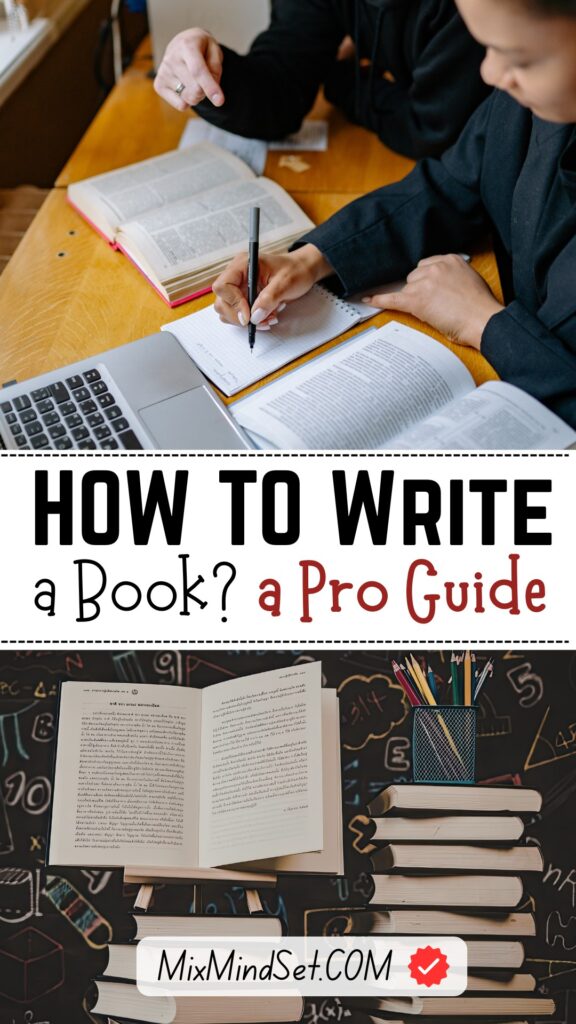
But every time you sit down to write, you stare at a blinking cursor. Doubt creeps in. Who am I to write a book? Where do I even start?
Here’s the truth: Writing a book isn’t magic. It’s a process. And processes can be learned.
In this guide, I’ll walk you through everything – from the first spark of an idea to typing “THE END” (and even what comes after). No gatekeeping. No fluff. Just a system that works.
📑 Quick Navigation
❌ Why Most People Never Finish a Book (It’s Not Laziness)
You’re not undisciplined. You’re not “not a real writer.” The real reasons are:
- 🧠 Perfectionism – They try to write a perfect first sentence and never move past page one.
- 📖 No roadmap – They start writing without knowing the ending, then get lost.
- ⏰ Inconsistent time – They wait for “a whole free weekend” that never comes.
- 😨 Fear of bad writing – They think every word must be brilliant immediately.
💡 Fact: Most bestselling authors wrote terrible first drafts. The difference is they finished.
1️⃣ Find Your Big Idea – In One Sentence
Before you write a single chapter, you need a core premise so clear you could explain it to a stranger in 10 seconds.
For fiction: “A young wizard discovers he’s the only one who can defeat the dark lord.” (Harry Potter)
For nonfiction: “A simple system to organize your home without becoming a minimalist.” (this guide’s vibe)
The “One Sentence” Formula
| Type | Formula | Example |
|---|---|---|
| Fiction | [Character] wants [goal] but [obstacle] | A retired assassin wants peace but must save her kidnapped niece. |
| Nonfiction | [Audience] learns [specific outcome] using [method] | Busy parents learn to cook healthy dinners in 20 minutes using meal prep. |
✅ Action step: Write your one sentence. If it takes longer than 2 minutes, your idea isn’t clear enough yet. Keep refining.
2️⃣ The Invisible Step That Saves You Months – Outlining
Skipping the outline is the #1 reason first‑time writers quit at page 50. An outline is not a cage – it’s a treasure map.
Simple outline templates
For fiction (3‑act structure):
| Act | What happens | % of book |
|---|---|---|
| Act 1 | Introduce character, normal world, inciting incident | 25% |
| Act 2 | Character faces challenges, learns, things get worse | 50% |
| Act 3 | Final confrontation, climax, resolution | 25% |
For nonfiction (problem‑solution structure):
| Section | Content |
|---|---|
| Chapter 1 | The problem (make reader feel understood) |
| Chapters 2–4 | The principles (why most solutions fail) |
| Chapters 5–9 | The step‑by‑step system |
| Chapter 10 | Troubleshooting & next steps |
✅ Action step: Write at least one sentence per chapter before you write any full prose. That’s your outline.
3️⃣ Set a Writing Schedule That Actually Sticks
You don’t need 4‑hour blocks. You need consistency.
| Type of writer | Best schedule | Daily word goal |
|---|---|---|
| Morning person | 6–7 AM, before work | 300–500 words |
| Night owl | 9–10 PM, after kids sleep | 300–500 words |
| Weekend warrior | Saturday 8–11 AM | 1,500 words |
| Lunch break writer | 12:30–1:00 PM (30 min) | 250 words |
🧠 Science: Writing 300 words a day = 9,000 words a month = a 60,000‑word book in under 7 months.
The “non‑negotiable” rule: Put your writing time on your calendar like a doctor’s appointment. No scrolling. No “I’ll do double tomorrow.” Just show up.
4️⃣ How to Write Badly (On Purpose) – Permission to Suck
Here’s the secret the pros know: The first draft is allowed to be garbage.
Your goal is not to write beautifully. Your goal is to get the clay on the table. You can sculpt later.
| Draft | Purpose | Mindset |
|---|---|---|
| Draft 1 (vomit draft) | Exist. Just get words down. | “No one will ever see this.” |
| Draft 2 | Make it coherent. Fix plot holes. | “Now it looks like a book.” |
| Draft 3 | Polish sentences. Improve flow. | “Now it reads well.” |
| Draft 4+ | Fine‑tune, cut, refine. | “Now it’s ready for readers.” |
✅ Action step: Write your first draft with your inner critic locked in the basement. Use placeholders like [insert better description later] or [something funny here] and keep moving.
5️⃣ Beating Writer’s Block for Good
Writer’s block isn’t a lack of ideas. It’s usually fear or not knowing what comes next. Here’s how to smash it.
| Problem | Solution |
|---|---|
| “I don’t know what to write next.” | Look at your outline. If outline is missing, go back and add a bullet point. |
| “It’s not good enough.” | Remind yourself: first draft is supposed to be bad. Lower the bar. |
| “I’m tired.” | Write 50 words. Just 50. That’s one paragraph. Often you’ll keep going. |
| “I have no motivation.” | Skip motivation. Use discipline. Sit down and write one ugly sentence. |
💡 The 5‑minute trick: Tell yourself you’ll write for only 5 minutes. Set a timer. After 5 minutes, you can stop. 90% of the time, you’ll keep writing.
6️⃣ The Editing Phase – From Ugly Draft to Real Book
Do not edit while you write the first draft. That’s like trying to paint a house while still building the walls.
Once your first draft is done, take a break (1–2 weeks). Then put on your editor hat.
Editing checklist (in order)
| Pass | Focus | What to do |
|---|---|---|
| Pass 1 | Big structure | Move chapters. Cut entire scenes. Add missing parts. |
| Pass 2 | Scene level | Does each scene advance plot or teach something? If not, cut it. |
| Pass 3 | Sentence level | Tighten flabby prose. Kill adverbs. Show, don’t tell. |
| Pass 4 | Grammar & typos | Read aloud. Use spell check. Print it out. |
✅ Pro tip: Change the font (e.g., from Times to Courier) before editing. Your brain sees it as a new document and catches more errors.
7️⃣ Beta Readers – Get Fresh Eyes
After you’ve edited as much as you can, give your book to 3–5 trusted readers. These are not your mom or your best friend (they’ll be too nice).
What to ask beta readers
| Question | Why it matters |
|---|---|
| Where did you get bored? | Find slow parts |
| What confused you? | Find unclear sections |
| Did you want to keep reading? | Measure engagement |
| Which character/chapter did you love most? | Know what to protect |
✅ Action step: Give beta readers 2–3 weeks. Don’t defend your writing – just listen and take notes.
8️⃣ Publishing Options – Traditional vs. Self‑Publishing
Once your book is polished, you need to decide how the world gets to read it.
| Aspect | Traditional Publishing | Self‑Publishing |
|---|---|---|
| Money | Publisher pays you an advance (often $5k–15k) | You pay upfront (editing, cover, formatting) |
| Control | Low – they decide title, cover, price | Total control |
| Time | Slow – 1–3 years from acceptance to shelf | Fast – can publish in 2 months |
| Royalties | 10–15% of book price | 40–70% (depends on platform) |
| Best for | Literary fiction, established experts | Genre fiction (romance, thriller, self‑help), niche topics |
Recommendation for first‑time authors: Start with self‑publishing on Amazon KDP. It’s free, fast, and you learn the ropes. You can always pursue traditional later.
9️⃣ A Realistic Timeline – From Idea to Published Book
Here’s a 6‑month plan for a 60,000‑word book (writing 2 hours per week).
| Month | Milestone | Word count goal |
|---|---|---|
| Month 1 | Outline + first 10 chapters | 10,000 words |
| Month 2 | Finish draft – chapters 11–20 | 20,000 words |
| Month 3 | Finish first draft (chapters 21–25) + celebrate | 30,000 words |
| Month 4 | Take a break (1 week). Then edit passes 1 & 2. | — |
| Month 5 | Edit passes 3 & 4. Send to beta readers. | — |
| Month 6 | Final polish. Format. Design cover. Publish. | — |
✅ Action step: Print this table and put it on your wall. Check off each month.
🔟 Printable Daily Word Count Tracker
Copy this table into a notebook or Excel file. Mark each day you write.
| Week | Mon | Tue | Wed | Thu | Fri | Sat | Sun | Weekly total |
|---|---|---|---|---|---|---|---|---|
| 1 | 350 | 0 | 400 | 300 | 0 | 600 | 200 | 1,850 |
| 2 | 400 | 450 | 0 | 500 | 300 | 0 | 700 | 2,350 |
| 3 | … | … | … | … | … | … | … | … |
Goal: 300 words/day = 2,100/week = ~9,000/month = a book in 7 months.
🧠 Conclusion
You don’t need a degree in English. You don’t need a fancy office. You don’t need to be “inspired.”
You just need a small commitment and a simple system.
- ✍️ Write 300 words today.
- 🗺️ Outline one chapter.
- ⏰ Put your writing time on the calendar.
And remember: Every finished book was once a blank page that someone refused to give up on.
Your story deserves to exist. Start today. Future you will be so glad you did. 🌟