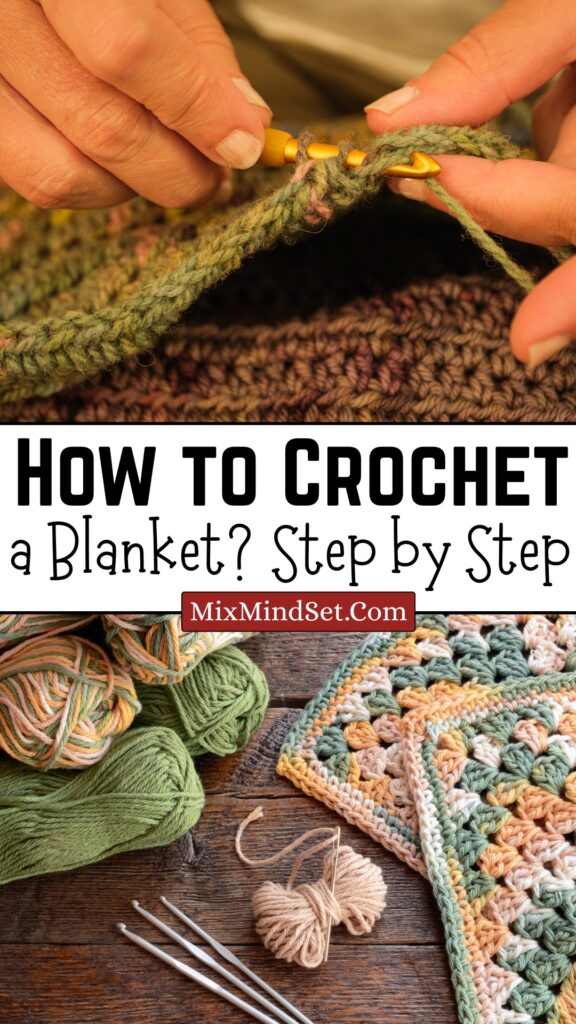
How to Crochet a Blanket?
There is something deeply satisfying about wrapping yourself in a blanket you made with your own two hands. 🧶 The soft yarn, the rhythmic movement of the hook, the slow growth of something beautiful — crochet is part craft, part meditation.
But if you have never held a crochet hook, a blanket can feel intimidating. That’s huge. Will it take forever? What if I make a mistake?
Here is the truth: A blanket is just one very long row, repeated many times. Once you learn two or three basic stitches, you can make any blanket. This guide will take you from “what is a skein?” to “I just finished my first blanket” — with clear tables, stitch descriptions, and practical tips. ✅
Quick Navigation
1. Why Crochet a Blanket? (The Real Benefits)
Before we talk about how, let’s talk about why. A crochet blanket is not just a home accessory. 🏠
- It is affordable therapy. The repetitive motion lowers stress and anxiety. Many therapists recommend crochet for mindfulness. 🧠
- You control the quality. No pilling, no weird chemicals — just soft, natural yarn you chose. 🌿
- It makes an unforgettable gift. A handmade blanket says “I spent hours thinking of you.” 🎁
- You can do it while watching TV. Once you learn the rhythm, your hands work on autopilot. 📺
💡 Fact: A standard throw blanket takes a beginner about 20–30 hours. That is one episode of a show per day for a month. Very doable.
2. Tools & Materials You Actually Need
You do not need a room full of supplies. Start with these five things. 🧰
| Tool | Why you need it | Approx. cost |
|---|---|---|
| Crochet hook (size H/8 or I/9 – 5mm or 5.5mm) | The most common size for worsted weight yarn | $2–5 |
| Worsted weight yarn (medium #4) | Easy to see stitches, not too thick or thin | $4–8 per skein |
| Scissors | For cutting yarn at the end | $1–3 |
| Yarn needle (plastic or metal) | To weave in loose ends | $2–4 |
| Measuring tape | To check blanket size as you go | $1–2 |
✅ Beginner tip: Buy one light‑colored yarn first. Dark yarn makes it hard to see your stitches. A soft cream or pastel blue is perfect.
3. Choosing the Right Yarn – No More Confusion 🧶
Yarn labels look like a secret code. Here is what the most important symbols mean.
| Symbol | Meaning | What to look for |
|---|---|---|
| 🧵 Weight symbol (a yarn ball with a number 0–7) | Thickness of yarn | For blankets: choose 4 (worsted) or 5 (bulky) |
| 🧺 Washing symbol | How to clean | “Machine wash, dry flat” is easiest |
| 🔥 Fiber content | Acrylic, cotton, wool | Acrylic is cheapest and softest for beginners |
Recommended yarn for your first blanket:
- Brand: Lion Brand Heartland, Red Heart Super Saver, or Bernat Blanket (if you want very thick and quick).
- Color: Light gray, cream, or soft sage green.
- Amount: A lap blanket (30″ x 40″) needs about 800–1,000 yards = 3–4 skeins.
😅 Pro tip: Buy one extra skein. Running out of yarn mid‑project is heartbreaking.
4. The 3 Essential Stitches (With Simple Descriptions)
You only need three stitches to make almost any blanket. Practice each on a small swatch first.
| Stitch | Abbreviation | What it looks like | When to use |
|---|---|---|---|
| Chain (ch) | ch | A series of loops like a braid | The foundation of every project |
| Single crochet (sc) | sc | Tight, dense, sturdy fabric | Baby blankets, washcloths |
| Double crochet (dc) | dc | Looser, airy, works up fast | Throw blankets, afghans |
How to make a double crochet (the most useful for blankets):
- Yarn over (wrap yarn around hook).
- Insert hook into stitch.
- Yarn over and pull through (3 loops on hook).
- Yarn over and pull through 2 loops (2 loops remain).
- Yarn over and pull through last 2 loops.
🎉 That’s it. Repeat 10,000 times and you have a blanket.
5. How to Start: Chain, Turn, and First Row
Every crochet project begins with a foundation chain. Let’s do it step by step.
Step 1 – Make a slip knot
Make a loop with the yarn, pull the working end through, tighten onto your hook. Not too tight – it should slide easily.
Step 2 – Chain the width of your blanket
If your pattern says “chain 120,” you make 120 chain stitches. Count carefully. Use stitch markers every 20 chains to avoid losing count. 🔢
Step 3 – Make the first row
Skip the first chain (that’s your turning chain), then double crochet into the second chain from the hook. Continue double crocheting into each chain across.
Step 4 – Turn your work
At the end of the row, chain 2 (for double crochet) or chain 1 (for single crochet). Flip the blanket like turning a page in a book. Now start the next row.
✅ Remember: The turning chain counts as the first stitch of the new row. So you skip the very first stitch and work into the second.
6. Blanket Sizes & How Many Chains You Need 📏
The number of chains depends on your yarn, hook, and personal tension. Always make a test swatch first.
How to calculate your starting chain:
- Crochet a small square (4″ x 4″) using your chosen stitch.
- Count how many stitches fit in 4 inches.
- Divide that number by 4 to get stitches per inch.
- Multiply stitches per inch by your desired blanket width.
Example: You want a 36″ wide lap blanket. Your test swatch shows 4 stitches per inch. 👉 4 stitches/inch × 36 inches = 144 chains to start.
Standard blanket sizes (width × length)
| Blanket type | Width (inches) | Length (inches) | Suggested starting chains (with worsted yarn, 4 sts/inch) |
|---|---|---|---|
| Baby blanket | 30″ | 36″ | 120 |
| Lapghan (lap blanket) | 36″ | 48″ | 144 |
| Throw blanket | 50″ | 60″ | 200 |
| Twin bed | 66″ | 90″ | 264 |
| Queen bed | 90″ | 90″ | 360 |
⚠️ For a first blanket, start small. A 36″ x 48″ lap blanket is perfect. You finish faster and feel proud.
7. Easy Beginner Blanket Patterns (3 Options)
Pick one of these. They are all repetitive rows – no counting after the first row.
Pattern A – Classic Double Crochet Blanket
Row 1: Double crochet in each chain across.
Row 2 and beyond: Chain 2, double crochet in each stitch across.
Repeat until desired length.
✔️ Pros: Works up fast, very forgiving.
Pattern B – Single Crochet Blanket (dense & warm)
Row 1: Single crochet in each chain across.
Row 2 and beyond: Chain 1, single crochet in each stitch across.
✔️ Pros: No holes, great for winter. Cons: Takes longer.
Pattern C – Corner to Corner (C2C) Blanket
This is a different technique – you work diagonally. Search “C2C crochet for beginners” on YouTube.
✔️ Pros: Modern look, easy to adjust size as you go.
📌 My recommendation: Start with Pattern A (double crochet). You will see progress quickly, and that keeps you motivated.
8. How to Change Colors (Without Knots)
Want stripes? A border in a different color? Here is the cleanest method.
To change color at the end of a row:
- Work the last stitch of the row until you have two loops left on your hook.
- Drop the old yarn. Pick up the new color.
- Yarn over with the new color and pull through both loops.
- Chain your turning chain with the new color.
- Continue crocheting.
- Leave a 6‑inch tail of both colors. You will weave them in later.
To change color in the middle of a row (for stripes): Same method, but you complete the stitch with the new color right where you want the stripe to start.
❌ Never tie knots. They come undone in the wash. Always weave ends with a yarn needle.
9. Finishing: Border, Weave Ends, and Wash
You finished the last row. Now what? Three final steps.
Step 1 – Fasten off
Cut the yarn, leaving a 8‑inch tail. Yarn over and pull the tail completely through the last loop. Pull tight.
Step 2 – Weave in all ends
Thread the yarn tail onto a yarn needle. Weave it horizontally through the “bumps” of at least 10 stitches. Then weave back the opposite direction. Trim excess.
Step 3 – Add a border (optional but beautiful)
Single crochet around the entire blanket. In corners, work 3 single crochets into the same corner stitch to turn the corner neatly. A simple border hides uneven edges.
Step 4 – Wash and block
- Machine wash cold, gentle cycle. Use a mesh laundry bag.
- Lay flat to dry (never hang – it stretches).
- “Blocking” means gently pulling the blanket into a perfect rectangle while damp. Use a foam mat and pins.
✨ Your blanket is now soft, straight, and ready to use.
10. Printable Stitch & Size Cheat Sheet 📋
Copy this table into your notes app or print it for reference.
Stitch summary
| Stitch | Abbreviation | Turning chain | Best for |
|---|---|---|---|
| Single crochet | sc | ch 1 | Dense, sturdy fabric |
| Double crochet | dc | ch 2 | Fast, drapey fabric |
| Half double crochet | hdc | ch 2 | Middle ground (great for blankets) |
Quick size calculator
| Desired width (inches) | × stitches per inch (from swatch) | = starting chains |
|---|---|---|
| Example: 36″ | × 4 | = 144 |
Pro tip: Always add 10 extra chains to your starting chain. You can unravel extras later, but running short is painful.
Conclusion
And that is perfectly fine. 🧡
Your edges might wave. Your tension might change. You might drop a stitch and not notice for three rows. Every single crocheter started exactly there.
The magic is not in perfection. The magic is in finishing. That moment when you hold up something you made – with your own hands, from a string – and you think, “I did that.”
So buy one skein, one hook, and watch a 10‑minute YouTube tutorial on the double crochet stitch. Then make your first 10 rows. Then 50. Then one whole blanket.
You have got this. 🧶