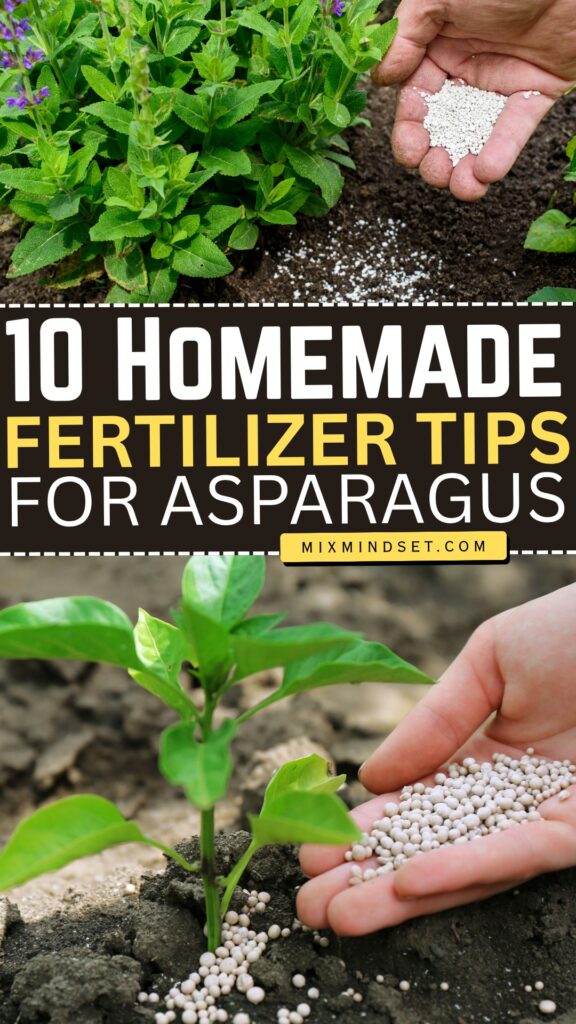
10 Homemade Fertilizer Tips for Asparagus
Feed your asparagus for free using simple kitchen scraps and natural ingredients. These 10 homemade fertilizer recipes will give you thicker, tastier spears without spending a dime on chemical plant food. #AsparagusCare #GardeningHacks #OrganicGardening #DIYGarden #GrowYourOwnFood
The first few years I grew asparagus, I had no idea it was such a heavy feeder. I planted my crowns, waited patiently, and ended up with thin, spindly spears that were nowhere near the fat, juicy stalks I dreamed of.
I thought I had done something wrong. Then I learned that asparagus is a nutrient-hungry perennial that needs regular feeding to produce those thick, tender spears.
Store-bought fertilizers can be expensive, but nature provides everything you need. Here are 10 homemade fertilizer tips that transformed my asparagus patch.
Why Asparagus Needs Regular Feeding
Asparagus is a perennial plant that produces spears for 15 to 20 years. That means it pulls nutrients from the soil year after year [8†L45-L46]. If you do not replace those nutrients, your spears will get thinner and weaker over time.
Asparagus needs a balanced diet of nitrogen, phosphorus, and potassium, plus trace minerals like calcium, magnesium, sulfur, and iron [7†L10-L15]. Nitrogen promotes lush, green foliage growth. Phosphorus builds strong root systems.
Potassium supports overall plant health and spear quality. Homemade fertilizers can provide all of these nutrients naturally and slowly, feeding your plants steadily throughout the growing season [6†L16-L18].
10 Homemade Fertilizer Tips for Asparagus
1. Rich, Homemade Compost
Compost is the single best thing you can give your asparagus. It provides a balanced mix of nutrients, improves soil structure, and feeds the beneficial microorganisms that help your plants thrive [6†L20-L22][7†L24-L27].
How to make it: Gather fruit and vegetable scraps, coffee grounds, grass clippings, and leaves [6†L22-L24]. Layer them in a compost bin with alternating green (nitrogen-rich) and brown (carbon-rich) materials [6†L25-L27]. Keep the pile moist and turn it every few weeks [6†L29-L30].
How to use it: Spread a layer of compost about 1 inch thick around each asparagus plant in early spring before new growth appears [6†L33-L35]. This provides slow-release nutrients all season long and improves soil moisture retention [6†L35-L37].
2. Compost Tea (Liquid Gold)
If you want faster results than solid compost, brew a batch of compost tea. It is a nutrient-rich liquid that your asparagus can absorb immediately.
How to make it: Steep a few shovelfuls of finished compost in a bucket of water for 24 to 48 hours [3†L37-L40]. Stir occasionally. Strain the liquid and use it to water your plants.
How to use it: Apply about 1 quart of compost tea per plant as a soil drench [3†L18-L19]. You can also use it as a foliar spray [3†L48-L49]. Apply it every 2 to 3 weeks during the growing season.
3. Coffee Grounds for Nitrogen
Coffee grounds are an excellent source of nitrogen, which asparagus loves for producing lush, green foliage [6†L37-L39]. They also improve soil drainage and aeration [4†L40-L41].
How to make it: Save your used coffee grounds from your morning brew. Let them dry to prevent clumping [6†L39-L40].
How to use it: Sprinkle the coffee grounds evenly around the base of each asparagus plant [6†L46-L47]. Do not bury them too deep—just work them lightly into the top layer of soil. Coffee grounds are slightly acidic, but asparagus tolerates that well [6†L46].
4. Eggshell Calcium Boost
Calcium is essential for strong cell walls and healthy spear development [6†L50-L52]. Eggshells are packed with it and are completely free [4†L28-L29].
How to make it: Collect your eggshells and let them dry completely [6†L52-L53]. Once dry, crush them into a fine powder using a blender or rolling pin [6†L53-L54].
How to use it: Sprinkle the crushed eggshells around the base of your asparagus plants or mix them directly into the soil [6†L54-L55]. The powder will release calcium slowly as it breaks down.
5. Banana Peel Potassium Boost
Banana peels are rich in potassium and phosphorus, two nutrients that asparagus needs for strong root growth and sturdy spears [9†L12-L14].
How to make it: Chop banana peels into small pieces. You can either dry them and grind them into powder or soak them in water.
How to use it: Option A: Bury chopped banana peels directly in the soil around your asparagus plants. Option B: Soak banana peels in water for 3 to 5 days, strain, and use the liquid to water your plants [9†L45-L47].
6. Wood Ash for Potassium and pH Balance
Wood ash is a great source of potassium, phosphorus, and calcium [10†L16-L17]. It also helps raise soil pH, which is beneficial since asparagus prefers a soil pH between 6.5 and 7.0 [10†L13-L14]. Only use wood ash from untreated wood—never from painted, stained, or pressure-treated wood.
How to make it: Collect ashes from your fireplace or fire pit. Let them cool completely before handling.
How to use it: Sprinkle a thin layer of wood ash around your asparagus bed in early spring or when preparing the soil for planting [10†L14-L15]. Use about 15 to 20 pounds per 1,000 square feet [10†L30-L31]. Do not overapply—wood ash is alkaline and can raise pH too much if used in excess.
7. Epsom Salt for Magnesium and Sulfur
Epsom salt provides magnesium and sulfur, two nutrients that help asparagus absorb nitrogen and phosphorus more effectively [12†L17-L18].
How to make it: Dissolve 1 tablespoon of Epsom salt in 1 gallon of water [1†L17][12†L14-L15].
How to use it: Use this solution to water your asparagus plants once every four weeks during the growing season [1†L18-L19][12†L15-L16]. You can also sprinkle a small handful of Epsom salt directly around the base of each plant and water it in [12†L38-L40].
8. Manure Tea for a Nitrogen Punch
Manure tea is a powerhouse fertilizer for heavy feeders like asparagus [13†L6-L7]. It delivers a quick, concentrated dose of nitrogen [13†L43-L44]. Always use well-aged manure—fresh manure can burn your plants.
How to make it: Place a few shovelfuls of aged manure in a bucket (or an old pillowcase) and cover it with water [13†L39-L40]. Let it steep for a few days until the water turns brown [13†L40]. Dilute the tea 1 part tea to 4 parts water before using [13†L11-L12].
How to use it: Pour about 1 pint of diluted manure tea around the base of each plant [13†L23-L24]. Apply it weekly during the growing season for best results [13†L24-L25].
9. Blood Meal and Bone Meal Blend
Blood meal is high in nitrogen, which promotes leafy growth [14†L22-L23]. Bone meal is high in phosphorus, which encourages strong root development [14†L23-L24]. Together, they provide a balanced meal for your asparagus [14†L25-L26].
How to make it: Mix equal parts blood meal and bone meal in a container. Store it in a sealed jar.
How to use it: Sprinkle about 1 cup of the blend per 25 feet of asparagus row in early spring and again in late summer [14†L5-L6][14†L33-L35]. Work it lightly into the soil and water well.
10. Kitchen Scrap Fertilizer (The Catch-All)
This is the ultimate zero-waste fertilizer. It combines multiple kitchen scraps into one powerful liquid feed.
How to make it: Collect vegetable and fruit peels, eggshells, coffee grounds, and other biodegradable kitchen waste in a bucket [8†L21-L22][4†L22-L25]. Fill the bucket with water and let it soak for 3 to 5 days in a covered container [9†L45-L47]. Stir daily, then strain the liquid.
How to use it: Use the strained liquid to water your asparagus plants [8†L23]. The leftover solids can be added to your compost pile. This method is slow but effective and completely free [8†L21-L24].
Quick Reference Table: 10 Fertilizers at a Glance
| Fertilizer | Key Nutrient | How to Apply | Frequency |
|---|---|---|---|
| Compost | Balanced NPK | Spread 1 inch around plants | Once in early spring |
| Compost Tea | Balanced NPK | Soil drench | Every 2-3 weeks |
| Coffee Grounds | Nitrogen | Sprinkle around base | Monthly |
| Eggshells | Calcium | Sprinkle powder on soil | Monthly |
| Banana Peels | Potassium, Phosphorus | Bury or soak in water | Monthly |
| Wood Ash | Potassium, Calcium | Sprinkle thin layer | Once or twice per season |
| Epsom Salt | Magnesium, Sulfur | Dissolve in water | Every 4 weeks |
| Manure Tea | Nitrogen | Dilute 1:4, soil drench | Weekly |
| Blood Meal + Bone Meal | Nitrogen, Phosphorus | Sprinkle 1 cup/25 ft row | Spring and late summer |
| Kitchen Scrap Fertilizer | Mixed nutrients | Soak scraps in water | Monthly |
My Personal Asparagus Feeding Routine
Here is what I actually do for my asparagus bed. You can copy this.
Early spring (before spears appear):
- I spread a thick layer of homemade compost around all my asparagus plants.
- I sprinkle a little wood ash and crushed eggshells on top.
- I water everything in well.
During the growing season:
- I brew compost tea every 2 to 3 weeks and use it to water my plants.
- I sprinkle coffee grounds around the base of each plant once a month.
- I use Epsom salt solution once a month.
After the harvest season:
- I let the ferny foliage grow tall and feed the plants with blood meal and bone meal in late summer.
- I add another layer of compost in fall to prepare them for winter.
Since I started this routine, my asparagus spears have grown thicker, tastier, and more abundant. The plants are healthier, and I have not bought commercial fertilizer in years.
Important Tips to Remember
- Do not overfeed. Too much fertilizer can burn your plants. Start with small amounts and increase gradually.
- Water after applying. This helps the nutrients soak into the soil where the roots can reach them.
- Avoid fresh manure. It can burn asparagus roots and introduce weed seeds. Always use well-aged manure.
- Test your soil first. If possible, get a soil test to know exactly what your asparagus needs.
- Be patient. Asparagus takes 2 to 3 years to establish. The feeding you do now will pay off for years to come.
- Let the ferns grow. After harvest season, do not cut down the ferny foliage. It feeds the roots for next year’s crop.
The Bottom Line
Asparagus is a hungry plant, but you do not need expensive fertilizers to feed it. Compost, coffee grounds, eggshells, banana peels, wood ash, Epsom salt, manure tea, and kitchen scraps all provide the nutrients your asparagus needs. These homemade fertilizers are cheap, natural, and effective.
I started feeding my asparagus with kitchen scraps and compost, and the difference was night and day. My spears went from thin and weak to thick and tender. Your asparagus can do the same. Start saving those scraps and give these homemade fertilizers a try.