Best Tall Narrow Trees for Small Yards
Transform your small yard with these stunning tall, narrow trees that add privacy, structure, and beauty without taking up precious ground space. From fast-growing Italian cypress to elegant columnar maples, this guide covers the best choices for compact gardens. #SmallYardTrees #NarrowTrees #PrivacyScreening #LandscapingIdeas #GardenDesign
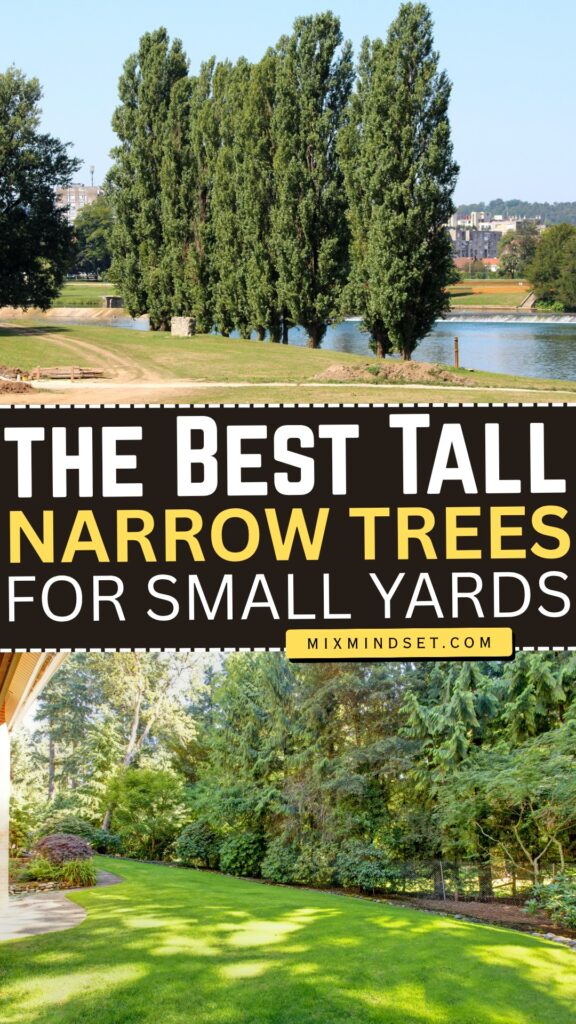
Finding the right tree for a small yard used to feel impossible. I spent months searching for something that would give me privacy without swallowing my entire garden.
Every tree I liked seemed to spread wider than my entire side yard. Then I discovered columnar trees—and everything changed.
These vertical wonders grow up instead of out, giving you height, structure, and screening without crowding your space. Here are the best tall, narrow trees that actually fit in small yards.
What Makes a Tree “Narrow”?
Trees with a narrow, upright growth habit are called columnar or fastigiate trees. They grow tall but stay slim, making them perfect for small spaces.
Most narrow trees have branches that grow upward rather than outward, creating a shape that resembles a pencil or a column.
Columnar trees are a great option for small gardens. They let you add height and visual impact without sacrificing precious ground space.
15 Best Tall, Narrow Trees for Small Yards
1. Italian Cypress (Cupressus sempervirens)
This is the ultimate tall, skinny tree. Italian cypress creates instant height and a dramatic architectural look. It’s perfect for lining driveways, creating borders, or standing tall at entryways.
It has a dense, columnar form with dark green evergreen foliage. It is drought-tolerant and low-maintenance.
Plant in full sun with well-drained soil.
2. Dwarf Italian Cypress ‘Tiny Tower’
This is a compact version of the Italian cypress, perfect for patios, containers, or very small gardens. It retains the same elegant, columnar shape as its larger cousin.
Excellent for patios and containers.
3. Emerald Green Arborvitae (Thuja occidentalis ‘Smaragd’)
This is a classic choice for narrow hedges and privacy screens. It stays bright green all year and is extremely cold-hardy.
Perfect for privacy screens, hedges, and windbreaks.
4. Sky Pencil Holly (Ilex crenata ‘Sky Pencil’)
This is one of the best options when space is extremely limited. It’s incredibly narrow, growing tall but staying remarkably slim. It requires no pruning to maintain its shape.
Perfect for containers, flanking entryways, or tight urban spaces.
5. Blue Arrow Juniper (Juniperus scopulorum ‘Blue Arrow’)
This striking juniper features silvery-blue foliage on a very narrow column. It’s drought-tolerant once established.
Excellent for vertical accents, rock gardens, or as a specimen plant.
6. Lombardy Poplar (Populus nigra ‘Italica’)
This is one of the fastest-growing tall, narrow trees. It creates instant presence in open backyards. It grows up to 6 feet per year. Height: 40–70 feet. Width: 10–15 feet. Hardiness Zones: 3-9. Best for larger properties where rapid screening is needed.
7. Columnar Maple Trees
These narrow deciduous trees give you height plus stunning fall foliage. They are hard to beat for seasonal interest. Various cultivars are available with different fall colors. They are ideal where seasonal change can be enjoyed up close.
8. Upright Hornbeam Trees (Carpinus betulus ‘Fastigiata’)
Hornbeam trees have a naturally tidy, upright habit that works well in formal designs. They respond well to pruning, making them great for symmetrical layouts and refined borders. Height: 20–30 feet. Width: 10–15 feet. Hardiness Zones: 5-8. Excellent for formal gardens and structured landscapes.
9. Pencil Point Juniper (Juniperus communis ‘Compressa’)
This is one of the most drought-tolerant narrow trees. It thrives in sunny, dry conditions and needs very little upkeep. Height: 6–10 feet. Width: 1–2 feet. Hardiness Zones: 4-8. Perfect for modern yards, gravel gardens, or low-water landscaping.
10. Skyrocket Juniper (Juniperus scopulorum ‘Skyrocket’)
This tree forms a stunning privacy screen with scale-like, blue-green leaves. It is very low-maintenance and tolerates drought well. Height: Up to 30 feet. Width: 2–3 feet. Hardiness Zones: 3-9. Perfect for xeriscaping and rock gardens.
11. Sky Tower Ginkgo (Ginkgo biloba ‘Sky Tower’)
This distinct ginkgo cultivar turns brilliant golden-yellow in fall. It grows tall and narrow. It tolerates urban soil conditions. Height: 20 feet. Width: 6–8 feet. Hardiness Zones: 5-8. Perfect for fall color and urban gardens.
12. Taylor Juniper (Juniperus virginiana ‘Taylor’)
This tree closely resembles the Italian cypress but is shorter and flourishes in frigid winters. It grows at an astounding rate of 3 to 5 feet per year. Height: 20 feet. Width: 4 feet. Hardiness Zones: 4-9. Perfect for cold climates and border plantings.
13. Japanese Holly (Ilex crenata)
This slow-growing, evergreen tree has glossy green leaves and produces small white flowers in summer. Height: Up to 8m. Width: Up to 1.5m. Hardiness Rating: H6. Excellent for privacy screens or garden edging.
14. Slender Silhouette Sweetgum (Liquidambar styraciflua ‘Slender Silhouette’)
This remarkable tree is very narrow and upright, with attractive star-shaped leaves that turn brilliant colors in fall. Height: 30–40 feet. Width: 3–5 feet. Hardiness Zones: 5-9. Excellent for fall color and tight spaces.
15. Columnar Apple Trees (Malus varieties)
These narrow flowering trees prove you don’t need wide canopies for stunning blooms. They add spring color without crowding the yard. Height: 8–10 feet. Width: 2–3 feet. Hardiness Zones: 4-8. Excellent for small gardens and containers.
Quick Reference Table: 15 Narrow Trees at a Glance
| Tree | Height | Width | Zones | Best For |
|---|---|---|---|---|
| Italian Cypress | 40-60 ft | 3-6 ft | 7-10 | Dramatic vertical impact |
| Dwarf Italian Cypress | 8-10 ft | 2-3 ft | 7-10 | Patios, containers |
| Emerald Green Arborvitae | 12-15 ft | 3-4 ft | 3-7 | Privacy screens, hedges |
| Sky Pencil Holly | 6-8 ft | 1-2 ft | 6-9 | Ultra-narrow spaces |
| Blue Arrow Juniper | 12-15 ft | 2 ft | 4-9 | Silvery-blue accent |
| Lombardy Poplar | 40-70 ft | 10-15 ft | 3-9 | Fast vertical growth |
| Columnar Maple | Varies | Varies | Varies | Fall color |
| Upright Hornbeam | 20-30 ft | 10-15 ft | 5-8 | Formal landscapes |
| Pencil Point Juniper | 6-10 ft | 1-2 ft | 4-8 | Drought-tolerant spots |
| Skyrocket Juniper | Up to 30 ft | 2-3 ft | 3-9 | Xeriscaping, rock gardens |
| Sky Tower Ginkgo | 20 ft | 6-8 ft | 5-8 | Fall color, urban gardens |
| Taylor Juniper | 20 ft | 4 ft | 4-9 | Cold climates |
| Japanese Holly | Up to 26 ft | Up to 5 ft | H6 | Privacy screens, edging |
| Slender Silhouette Sweetgum | 30-40 ft | 3-5 ft | 5-9 | Tight spaces, fall color |
| Columnar Apple | 8-10 ft | 2-3 ft | 4-8 | Spring blooms, containers |
How to Choose the Right Narrow Tree for Your Yard
Consider Your Goal
- For privacy: Choose evergreen trees like Italian Cypress, Emerald Green Arborvitae, or Sky Pencil Holly.
- For seasonal color: Choose deciduous trees like Columnar Maple, Sky Tower Ginkgo, or Slender Silhouette Sweetgum.
- For containers: Choose smaller varieties like Dwarf Italian Cypress, Sky Pencil Holly, or Columnar Apple trees.
- For cold climates: Choose cold-hardy options like Emerald Green Arborvitae, Taylor Juniper, or Skyrocket Juniper.
Consider Your Space
Measure the width of your planting area. For very tight spaces (1-2 feet wide), choose Sky Pencil Holly or Pencil Point Juniper. For slightly wider spaces (2-4 feet wide), choose Italian Cypress, Blue Arrow Juniper, or Emerald Green Arborvitae. For larger spaces (5-10 feet wide), choose Columnar Maple or Upright Hornbeam.
Consider Your Climate
Check your USDA hardiness zone before buying. Italian Cypress thrives in zones 7-10. Emerald Green Arborvitae thrives in zones 3-7. Sky Pencil Holly thrives in zones 6-9. Skyrocket Juniper thrives in zones 3-9. Taylor Juniper thrives in zones 4-9.
Planting and Care Tips for Narrow Trees
Planting Tips
- Dig a wide hole: Dig a hole twice as wide as the root ball but no deeper.
- Space properly: For a privacy screen, plant narrow trees 2-4 feet apart, depending on the variety.
- Water deeply: Water thoroughly after planting and during the first year.
- Mulch: Add a layer of mulch around the base to retain moisture and suppress weeds.
Care Tips
- Water: Most narrow trees are drought-tolerant once established, but water during dry spells.
- Prune: Many narrow trees require little pruning to maintain their shape. However, some respond well to pruning for a neater appearance.
- Fertilize: Apply a balanced fertilizer in early spring for healthy growth.
- Protect from winter damage: In cold climates, protect young trees from harsh winter winds.
My Personal Narrow Tree Story
The first time I planted a row of Italian cypress along my side yard, I felt like I had reclaimed my privacy. My yard was small, and I had always felt overlooked by the neighbors.
Those tall, slender trees grew quickly and created a living wall that blocked the view without blocking the light. Now my side yard feels like a private sanctuary.
I’ve since added a Sky Pencil Holly near my front door for a polished, architectural look. These narrow trees have transformed my small yard into a space that feels much larger and more intentional.
The Bottom Line
You don’t have to sacrifice vertical interest or privacy just because your yard is small. Italian Cypress, Emerald Green Arborvitae, Sky Pencil Holly, and Blue Arrow Juniper are all excellent choices that grow tall without spreading wide.
For seasonal color, consider Columnar Maple, Sky Tower Ginkgo, or Slender Silhouette Sweetgum. For cold climates, choose Taylor Juniper or Skyrocket Juniper.
I used to think my small yard couldn’t handle trees. Now I know that the right narrow trees can transform a compact space into a private, beautiful retreat. Your yard can do the same. Choose the right tree for your space, give it a good start, and enjoy the height, structure, and privacy it brings.