How to Care for a Chrysanthemum Plant?
Every September, garden centers and supermarkets are filled with autumn chrysanthemums in full bloom. By spring, many of those pots are empty. That’s not bad luck. It mainly depends on which chrysanthemum you brought home and when you planted it.
So, are chrysanthemums perennials? The plant itself is. Chrysanthemum x morifolium, the chrysanthemum marketed as both “garden chrysanthemum” and “florist chrysanthemum,” is a hardy perennial, thriving down to about USDA zone 5.
Getting yours to bloom again is another matter. This guide explains how to care for potted and ground-planted chrysanthemums, how often to water them, the types of chrysanthemums you’ll find for sale, and what it takes to get your garden and potted chrysanthemums to bloom again next fall.
Are chrysanthemums perennial plants?
Yes, most chrysanthemums are perennials. Chrysanthemum x morifolium is hardy in USDA zones 5 through 9, according to North Carolina State University Extension and Illinois Extension, and in the South, it overwinters outdoors with minimal care.
The key is in the word “most .” Florist chrysanthemums, those sold in pots year-round, are not bred for winter, and many fall-blooming chrysanthemums purchased in full bloom die before reaching a second season.
The difference lies mainly in two aspects: what type of chrysanthemum you bought and when you planted it.
Garden chrysanthemums versus florist chrysanthemums
Both are chrysanthemums and, at first glance, may appear identical. However, they are not cultivated for the same purpose.
Florist chrysanthemums are the potted plants sold year-round at flower shops and supermarkets, often wrapped in foil or with a decorative pot cover. They need a long period of uninterrupted darkness before forming buds, so outdoors they bloom in late fall, and frost usually kills the buds before they open.
Iowa State University Extension is blunt about it: most florist chrysanthemums won’t survive the Iowa winter, and the few that do rarely rebloom outdoors. Enjoy them indoors, and then compost them.
Garden chrysanthemums, often marketed as “hardy chrysanthemums,” are more cold-hardy and require a shorter period of darkness, so most bloom in early fall. The University of New Hampshire Extension adds that single-flowered varieties are harder to bear than double-flowered florist varieties, citing ‘Hillside Sheffield Pink’ and Chrysanthemum weyrichii ‘White Bomb’ as examples.
Why can a florist sell chrysanthemums in May? Chrysanthemums are short-day plants: they form buds when the nights lengthen, so they bloom in the fall. Greenhouse growers illuminate the plants to encourage growth and then darken the greenhouse to induce flowering—a routine we explained in our article on how chrysanthemum cultivation works.
That same sensitivity can work against you at home. Both Iowa State University and the Illinois Extension warn that a chrysanthemum planted near a streetlight or house light may bloom late or not at all.
Why do most autumn chrysanthemums die?
A chrysanthemum purchased in September is often sold at its peak, forming a compact mound with all the buds open. That looks great on a porch, but it’s detrimental to a plant you want to preserve.
Penn State Extension explains it simply: a chrysanthemum planted in the fall when it’s already in bloom may not survive the winter, as it dedicates its energy to the flowers instead of the roots.
Then there are the roots themselves. Chrysanthemums have shallow, fibrous roots, and when the ground freezes and thaws repeatedly, the plant can be uprooted, notes Iowa State University.
A chrysanthemum planted in the fall has had weeks, not months, to establish itself. Illinois Extension adds that drought-stricken plants are less likely to survive the winter, and chrysanthemums don’t like to have wet feet, so a low, waterlogged spot finishes what the cold starts.
The solution starts at the garden center. Gary Bachman, a horticulturist with Mississippi State University Extension, advises choosing plants with buds just beginning to open, as these offer the longest-lasting display of color.
The Illinois Extension makes the same point about late-season chrysanthemums, which, although they may still look green and plain on the display counter, allow you to enjoy the entire blooming season at home instead of just the end.
How to care for chrysanthemums in pots and in the garden
Chrysanthemum care depends on your plan. A potted chrysanthemum on the porch only needs to look good until the first frost. A chrysanthemum you want to bloom again next year needs to be planted in the ground early and receive some attention in the spring.
How to care for potted chrysanthemums
Outdoors, place potted chrysanthemums in full sun. Gary Bachman of Mississippi State University says that’s where they bloom best, and Iowa State University and Illinois Extension recommend at least six hours of direct sunlight for chrysanthemums planted in the ground.
Indoors, a florist’s chrysanthemum thrives in a bright spot, but out of direct sunlight, at a temperature between 16 and 21 °C (60 and 70 °F), according to Iowa State University. In either case, deadhead spent blooms as they appear, since Pennsylvania State University notes that regular deadheading helps prolong flowering.
When frost is expected, bring potted plants indoors, into a shed or garage, or cover them with a light sheet, as suggested by the Illinois Extension. If a pot is inside a decorative cover, remove it to water it and replace it once the water has drained.
How often should chrysanthemums be watered?
More often than you think. A potted chrysanthemum in full bloom is a large plant in a small amount of soil. The Illinois Extension recommends watering potted chrysanthemums every other day, or at least whenever the top 1 inch (2.5 cm) of soil is dry. Water until water runs out of the drainage hole, ensuring the entire root ball is moistened, not just the surface.
Water the soil, not the leaves. Wet leaves encourage fungal growth, says Gary Bachman of Mississippi State University, and a potted plant that dries out loses color, which takes time to recover. Clemson Cooperative Extension adds that chrysanthemums need more water during bloom.
Chrysanthemums planted in the ground are easier to care for. Iowa State University recommends consistent watering, 5 cm (2 inches) of mulch around the plants, and watering every 7 to 10 days when the soil is dry during prolonged periods of drought.
When to plant chrysanthemums so they bloom again
In spring. Iowa State University Extension, Illinois Extension, Pennsylvania State University Extension, and the University of New Hampshire Extension all agree: a chrysanthemum planted in spring has a full growing season to establish itself before winter. Pennsylvania State University Extension recommends early spring, once all danger of frost has passed.
Are you planting an autumn chrysanthemum anyway? Put it in the ground as soon as you bring it home. Pennsylvania State University advises planting it at least six weeks before the first frost to give the roots time to establish.
Choose a sunny, well-drained spot, preferably sheltered, close to the house but away from outdoor lights. Plant the chrysanthemum at the same depth it was growing in its pot, and space them 18 to 24 inches (45 to 60 cm) apart, as recommended by Iowa State University.
How to care for chrysanthemums during winter
Leave them alone in the fall. Although it may seem messy, research cited by Iowa State University and the Illinois Extension shows that garden chrysanthemums survive best when older stems remain standing through the winter.
Once the ground begins to freeze, add mulch. The Illinois Extension suggests a 4-inch (10 cm) layer, and Iowa State University recommends straw or pine needles in late November or early December.
Avoid using fallen leaves, as they clump together and can damage the plants. Remove the mulch in early spring and cut back the previous year’s stems as new growth begins.
Don’t have time to plant them? Illinois Extension’s solution for potted chrysanthemums is simple: after a hard frost, move the pot to a cool, dark place, and then put it back outside when the weather warms up in spring.
Pruning chrysanthemums in spring
A chrysanthemum that reblooms grows taller and becomes lazier unless its tips are pinched back. When new growth reaches 15 cm (6 inches), pinch off the tips, and pinch back again when the side shoots reach the same length.
Both Iowa State University and the Illinois Extension recommend stopping pinching by early July, and gardeners use July 4th as a reminder. If you pinch back later, the flowers will take longer to appear.
Taken to the extreme, this same technique results in the Japanese thousand-flower chrysanthemum, a plant trained to produce hundreds of blooms.
Iowa State University advises fertilizing with a slow-release fertilizer when new growth begins in spring and omitting summer fertilization to prevent the plant from producing soft, spindly shoots in the fall.
They also recommend dividing garden chrysanthemums every two to three years in early spring, as soon as new growth appears.
Types of chrysanthemums and which ones are perennial
The National Chrysanthemum Society classifies chrysanthemums into 13 bloom types, ranging from giant, inward-curving blooms to thread-like ones, as explained in the New York Botanical Garden Library guide.
You’ll find some of these varieties at a garden center, but not all are equally hardy. The Iowa State University Chrysanthemum Type List indicates which varieties are hardier, and it’s a list worth consulting before buying.
“Cushion” type chrysanthemums
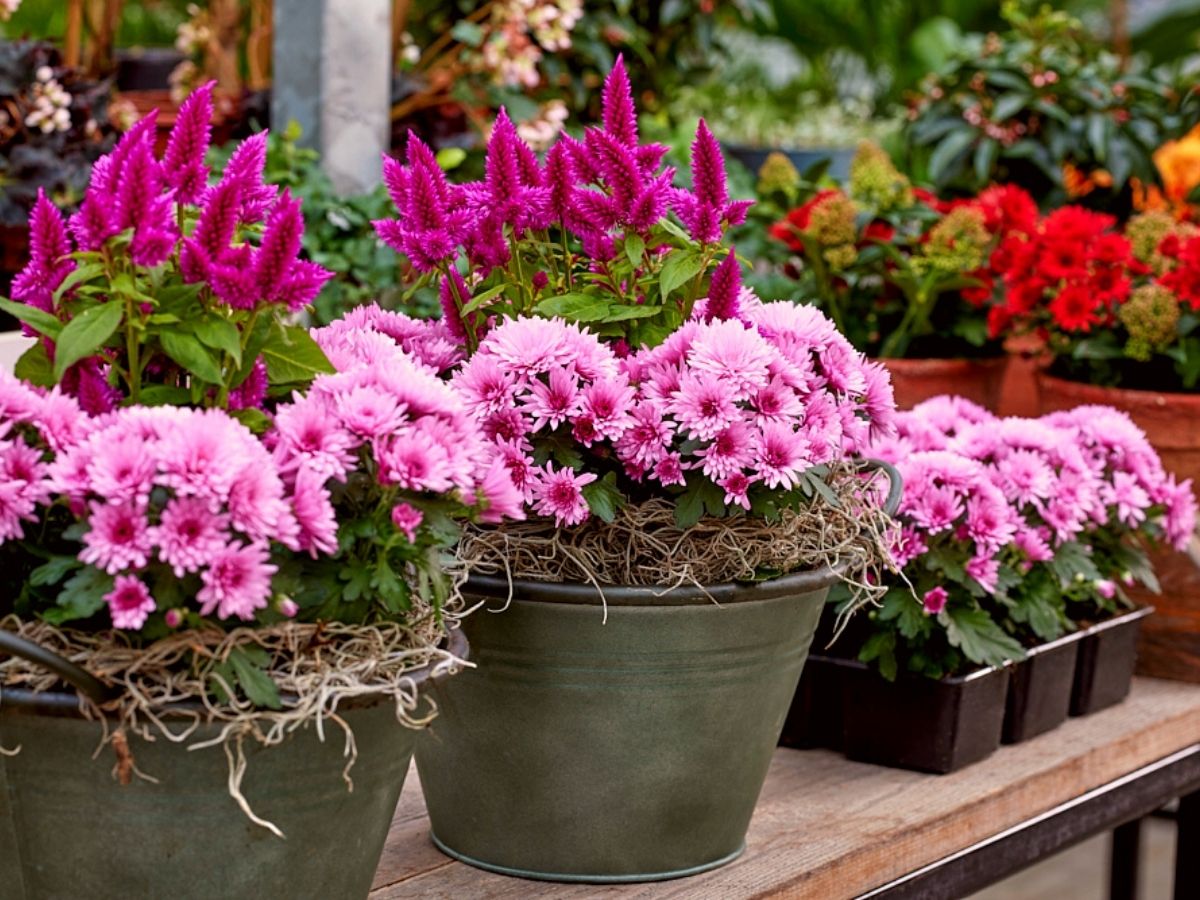
These are the low-growing, bushy, dome-shaped plants that fill garden center displays in September. Iowa State University describes cushion chrysanthemums, often called azaleas, as early-blooming, with most cultivars being cold-hardy.
Strictly speaking, the term “cushion” describes the plant’s shape rather than the flower itself, as Clemson notes. Compact garden chrysanthemum series, such as Royal Van Zanten ‘s ‘Multiflora’ PaX, achieve this rounded form.
Decorative chrysanthemums
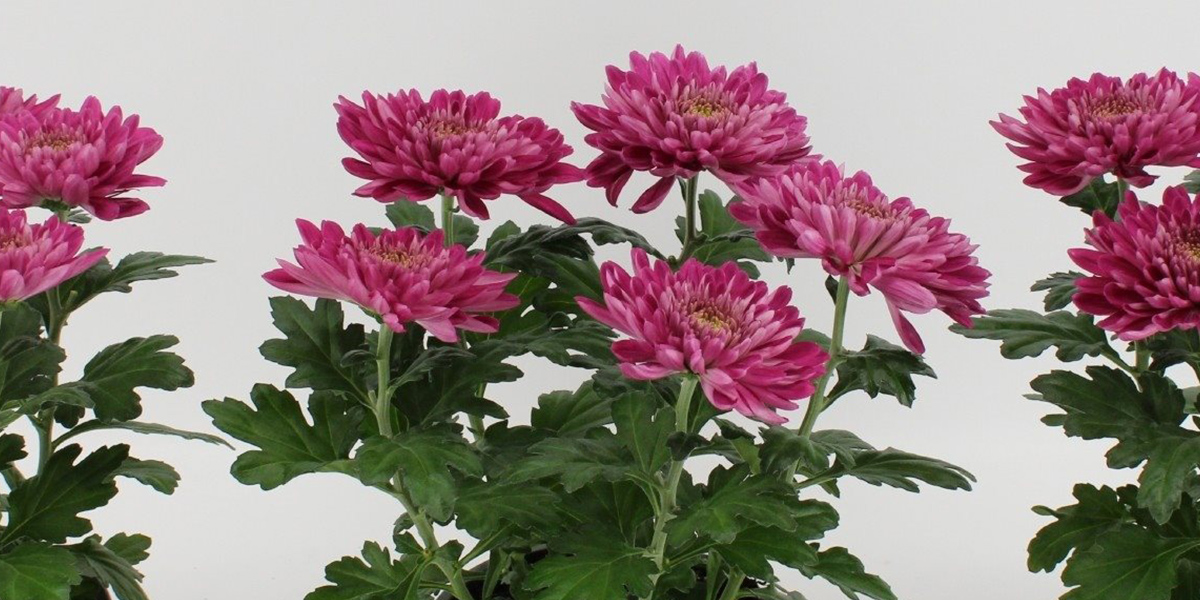
Decorative varieties have double or semi-double flowers with short petals; the upper petals curve inward and the lower ones droop downward. The NYBG guide describes this as a very common type often found among garden chrysanthemums, and Iowa State University lists many hardy cultivars within this group.
The pot chrysanthemum variety ‘Chrysanthemum Zembla Desna’, with its large, full, purple flowers, has a double, voluminous appearance.
“Pompon” and “Button” Chrysanthemums
Pompons are small, stiff, nearly round flowers, and Iowa State University has several hardy cultivars among them. Buttons are the smaller version, with double flowers less than 2.5 cm (1 inch) in diameter, according to Illinois Extension.
That same round shape is appreciated in vases as cut flowers, in varieties like Dekker Chrysanten ‘s ‘Chrysanthemum Momoko,’ which forms pink pom-poms.

Simple chrysanthemums and daisies
The single flowers resemble daisies, with several rows of long petals surrounding a flat center, as described by Iowa State University, and the group includes many hardy cultivars.
The hardiest varieties noted by the University of New Hampshire Extension are also single-flowered. Among cut flowers, Deliflor ‘s ‘Chrysanthemum Midnightsun’ exhibits this appearance, with orange petals that range from light to dark around a green eye.

Chrysanthemums “Anemone”
An anemone chrysanthemum resembles a semi-double flower with a raised center, which the NYBG guide likens to a pincushion. Iowa State University states that most cultivars in this group are hardy. The variety ‘Chrysanthemum Sunda’ exhibits this form, with purple petals edged in white surrounding a yellowish-green, anemone-like center.

“Spider” and “Feather” Chrysanthemums
The “spider” varieties have long, tubular petals that curve or twist at the tips; “quill” varieties have straight, tubular petals; and “spoon” varieties end in a spoon-like shape.
These are the chrysanthemums least likely to rebloom: Iowa State University lists few hardy cultivars among the “spider” and “quill” varieties, and only a few among the “spoon” varieties.
As cut flowers, they are easy to enjoy. The variety “Chrysanthemum Capriool,” bred by Dekker Chrysanten, features the “spider” form, with numerous long, narrow, thread-like petals.

Chrysanthemums ‘Spray’, ‘Disbud’ and ‘Santini’ at the flower shop
Stem chrysanthemums are classified differently. A cluster chrysanthemum has several flowers on a branching stem, like the ‘Midnightsun’ pictured above. A ‘disbud’ has had its side buds removed, so a single large flower commands all the attention.
A ‘Santini’ is a cluster of small flowers with a compact form, as explained in our article on growing chrysanthemums. Growers like Staalduinen Chrysanten in ‘s-Gravenzande, the Netherlands, cultivate cluster chrysanthemums for cutting in colors ranging from white to purple, including orange and red.
David Marín, Deliflor’s director for the Americas, named the “disbud” as his favorite flower in his “10 Questions” interview on Thursday: “My favorite flower is the Magnum variety, a large, hardy, and long-lasting chrysanthemum grown by Deliflor. It’s a striking and impactful flower that stands out in any floral arrangement.”

Santinis, such as Dekker Chrysanten’s Doria Orange, bring small, hardy blooms to autumnal designs. For ideas with cut chrysanthemums, discover how florists use chrysanthemums in autumn floral arrangements.
For vase care, Chrysal’s chrysanthemum care tips, available on Thursday, cover conditioning and flower nutrients, while the feature on El Trigal Manantiales traces the journey of Colombian chrysanthemums to the vase.
Breeders continue to add new shapes and colors, as Eliana Díaz of Danziger explains in our interview about chrysanthemum cultivation.

One color that garden chrysanthemums have never had is blue. BluOcean chrysanthemums, with their blue tones, are an exception obtained through crossbreeding. They are grown as cut flowers in Colombia and, at the time of our 2025 report, were sold in the United States, Canada, and Australia.
In Texas, a “mum” is also something you wear. The “homecoming mum” started as a real chrysanthemum with ribbons, pinned to the clothing of the person you were dating, and today it’s made with artificial flowers so it can last, Spectrum News reports, citing Texas Highways.
Are chrysanthemums toxic to cats and dogs?
Yes. The ASPCA classifies chrysanthemums as toxic to dogs, cats, and horses. The plant contains sesquiterpene lactones and pyrethrins, and symptoms include vomiting, diarrhea, excessive salivation, lack of coordination, and skin irritation.
For humans, North Carolina State University Extension rates the severity of poisoning as low, although contact with the leaves can cause a mild rash in sensitive individuals. Keep potted chrysanthemums out of reach of pets; if a pet bites them, call your veterinarian or the ASPCA Animal Poison Control Center.
If you want your porch planter to still have a plant next year, buy it when it’s in bud, plant it early, water it like it’s the most important thing in the world, and leave the dead stems in place until spring. If it’s a florist’s chrysanthemum, enjoy it at home and then let it go.
For company in the garden, our lists of fall-blooming flowers, autumn garden plants, and fall flowers for designs and gardens pick up where the chrysanthemums leave off. Want to know what your chrysanthemums mean? Our guide to chrysanthemum meaning and symbolism explores each color, and the history of this flower dates back to China, where it was already being cultivated as a crop in the 15th century BC.