How to Grow a Blueberry Bush in a Pot?
In this blog post, we’ll show you how to properly plant blueberries in your garden, allotment, or patio, highlighting the differences compared to planting blueberries for commercial use. We’ll explain, step by step, most of the questions you might have when buying and planting blueberries.
If we want to succeed with our blueberry plants and produce fruit for many years, we must consider several factors when planting blueberries: selecting the right varieties, soil or substrate type, altitude, spacing between plants, irrigation, fertilization, and flowering. We will break down each of these factors step by step below.
It’s only planted once! So it’s important to consider all these factors. Let’s get started with the first and most frequently asked question:
When are blueberries planted?
As we explained in general for all berries in the FAQ section, the best time to plant blueberries is from early autumn to mid-spring. Planting blueberries, whether in the ground or in pots, causes a little stress to the plant, but if we do this when temperatures are not high and the plants are dormant (winter) or have low photosynthetic activity (autumn/spring), we won’t have any problems at all. The idea is to avoid the hottest months, mainly summer, and thus avoid risks usually caused by lack of water (water stress).
However, with our potted plants, and especially with larger plants that have extensive and well-developed root systems, planting can be done even in summer. It’s necessary to have an irrigation system already installed so that, as soon as planting, the blueberry plants can be watered thoroughly during the first few days to facilitate their adaptation and reduce planting stress. It’s also advisable, if planting in summer, to do so in the early morning or late evening to avoid the hottest part of the day.
How are blueberries planted?
When planting a blueberry plant in the soil or substrate, the root ball should be planted with the surface of the root ball slightly buried, never more than 1 cm deep, and the soil around it should be pressed down to prevent air pockets.
If the root ball is buried too deeply, few new shoots will emerge from the base, and if it is buried too shallowly, the plant will be unstable and may be damaged, in addition to affecting its root development.
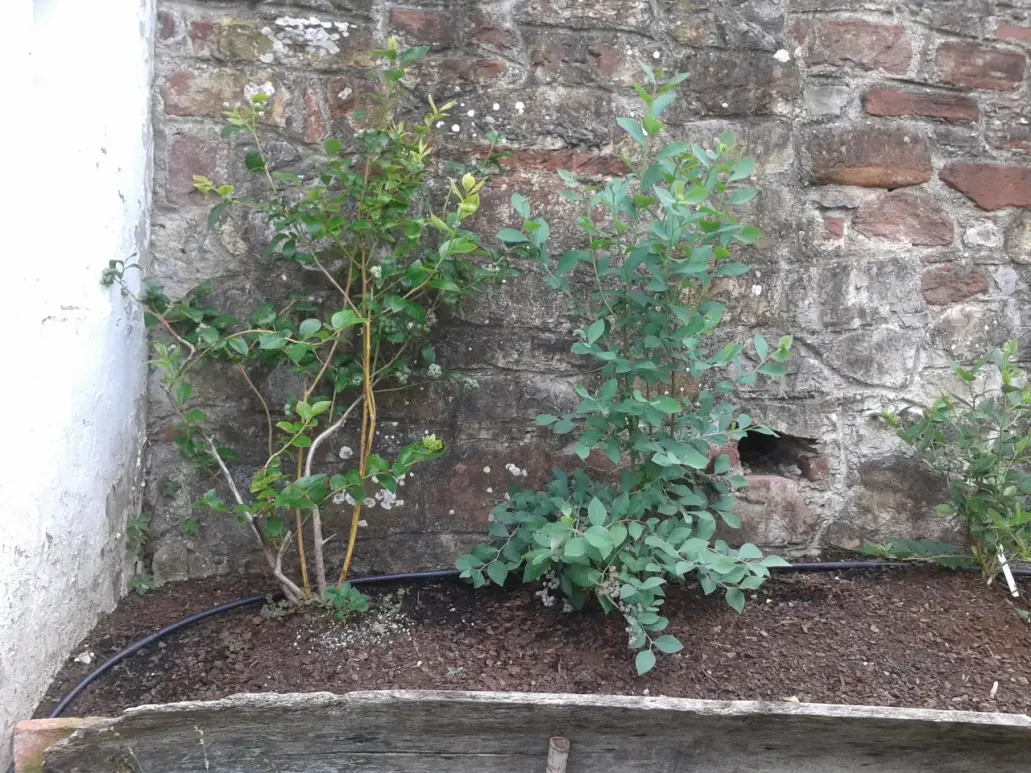
It is very important to always open the root ball of your plants before putting them in the ground.
In what orientation should I plant the blueberries?
We must keep in mind that red berries are mostly native to undergrowth, meaning they grow in the shade of trees. Therefore, except in temperate zones like Northern Spain, where they can be grown in sunny (south-facing) locations, in the rest of Spain it is advisable to plant them in a location with partial shade. For example, we can look for a location that is sunny in the mornings and shady in the afternoons.
If the location is not shaded, we must either place a light shade structure or, if necessary, significantly increase the frequency of watering if the plants are going to be in full sun all day.

Does a small blueberry plant adapt better than a large one?
Not at all; the adaptation process is the same, and with a large blueberry plant, everything will be much faster and easier, especially in the first few years of cultivation. That’s why more and more people, both farmers and hobbyists, are using our XL blueberry plants.
Up to what altitude can I plant blueberries?
Blueberries can be planted at altitudes up to 1,400 meters without any problems. According to several trials in the Pyrenees, their development slows down above that altitude, and cultivation becomes very difficult above 1,600-1,700 meters.
What type of soil/substrate do blueberries need?
Blueberries need acidic, light, and well-drained soil to thrive. But don’t worry! It’s easy to create acidic soil, and most of the time we already have slightly acidic soil.
If we have clay or heavy soil, we absolutely must amend and acidify it. The best option is to dig a hole 1 meter in diameter and 40 cm deep. We discard half of the excavated soil and mix the remaining 50% with pine bark, peat moss, or acidic soil to ensure the roots are in acidic soil and our blueberry plants grow properly. For slightly alkaline or clay soils, a 20-25% mixture will be sufficient.
If you want to grow blueberries in pots, you should use an acidic substrate for growing in pots or planters, as we explained in the frequently asked question “Can you grow blueberries in pots?”
ATTENTION! Adding pine bark only to the surface has a weed-suppressing effect but little acidifying power. We often think this is enough, but it isn’t. To properly acidify the soil, the pine bark must be mixed in with the soil itself so that it’s in contact with the roots. If you add it on top, its acidifying power is greatly reduced.
As a recommendation, regardless of your soil type, it’s always a good idea to add some pine bark mixed with your soil, which, in addition to making the soil lighter (and providing more oxygen), acidifies it as it decomposes.
When growing plants in pots, never use soil from the ground, as its high bulk density will cause it to harden into concrete, preventing root development. Always use an acidic potting mix specifically formulated for pots!
And how far apart should I plant the blueberry plants?
The recommended spacing between blueberry (Vaccinium corymbosum) plants, including pink or red blueberries, is 70 cm to 1 meter within the same row. They can be planted farther apart, but this will result in very large plants and make pruning more difficult. On the other hand, planting them closer together is not recommended, as it will reduce yield.
In the specific case of plants of the genus Vaccinium ashei known as “Rabitteye” or “Rabbit Eye,” such as the Centra blue or Skyblue varieties, it is recommended to use 1 meter of separation due to the larger size of these plants.
Regarding the spacing between rows or planting lines, that is, the aisle between them, there are significant differences between professional planting, which is around 3 meters, and the case of a vegetable garden or flower garden.
In the latter case, where we don’t usually need large machinery for maintaining or cultivating the rows, a distance of about 2 to 2.5 meters between rows can be left.
And how tall is a blueberry plant? How tall does a blueberry grow?
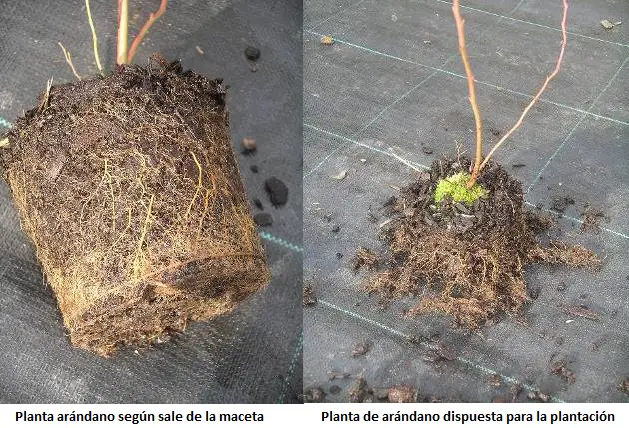
It depends on the blueberry variety. Most blueberry and rose blueberry plants reach 1.8 meters in height. However, there are smaller plants, such as the double-harvest blueberry, which doesn’t exceed 150 cm in height, or the dwarf blueberry, which doesn’t exceed 100 cm.
On the other hand, Siberian blueberries, also known as honeysuckle blueberries, can reach 1.6 meters in height. As for cranberries, they are rather creeping plants; while the European lingonberry doesn’t exceed 50 cm in height, the American cranberry is entirely creeping, although its stems can grow up to 2 meters long. Regarding wild blueberries, they typically range between 50 and 100 cm in height, depending on the region.
And once these questions have been answered, it is inevitable to ask the following question:
How do I choose the right blueberry varieties for my area?
Today we have varieties adapted to almost any climate, especially for blueberries, from the coldest areas of Spain such as Castilla-La Mancha, Soria or the Pyrenees to the warmest areas such as Murcia, Madrid, Barcelona or Seville.
To make it easier, in each of the varieties you will see different logos with the main characteristics, which will serve as a guide to know if that variety tolerates the climatic conditions of your area.
Technically, varieties are classified according to their chilling requirements, which agronomically are called “chilling hours,” and which we explain in the FAQ section. However, since this information is rarely known or properly understood, on our website you will find the main characteristics of each variety, making it easy to determine if they can withstand the soil and climate conditions of your area.
What should be clear is that these values are averages; all plants have a tolerance range above or below these values! One of the most important factors to consider is the cold resistance of blueberry varieties, since we have varieties that withstand -30°C in winter and others that barely withstand -5°C; the latter are the varieties intended for warm climates.
And what about the flowering of my blueberry plants? The greater the plants’ resistance to low temperatures, the later they will flower, sometimes starting in May to avoid spring frosts as much as possible. In contrast, varieties from warmer climates can flower very early, as early as February.
How do I water blueberry plants? Do blueberries need a lot of water?
Well, it depends. And it depends on your soil and climate conditions (temperature and rainfall). Sandy soil in Huelva at 45 degrees Celsius with a dry summer is not the same as clay loam soil in Asturias at 25 degrees Celsius with a rainy summer.
Would you like to drink water only 3 days a week in summer? Of course not, right? Well, neither would plants! Remember, they are living beings just like you and me!
What we want you to understand is that there are several factors that modify irrigation conditions, and the same irrigation frequency or the same amount of water is not always needed.
As a general rule for our gardens and terraces in summer, blueberry plants should be watered daily. Therefore, the best option is to install a simple irrigation system with a battery-operated timer and drip tubing. All of this costs less than $50, and you can forget about having to water by hand or forgetting to water for several days.
Depending on the type of soil, whether it retains more or less water, the watering should be more or less frequent. The idea is to keep the soil moist and not let it dry out completely, which is when we will cause problems for the plants. Simply scratching the soil a little with your fingertips will show you whether or not there is moisture in the soil.
Obviously, if a rainy summer comes along, as sometimes happens in Asturias, there will be weeks when you might only water for 3 or 4 days.
During autumn, we will gradually reduce watering (to about 3 days per week) until we see the plants begin to turn red with the arrival of colder weather, at which point we can stop watering completely. In very cold areas, this will be in October, and in less cold areas, it will be in November or December.
On the other hand, if you live in very warm areas like Seville, for example, where there’s hardly any cold in winter and where plants don’t completely stop growing, you probably won’t stop watering until winter arrives. We’ll adjust it according to the climate in our area.
In late winter (in warmer climates) or early spring (in colder climates), once the flower buds open, we will resume watering. Typically, during the first month after the flower buds open, watering three days a week is sufficient. Then, depending on temperatures and rainfall, we will increase the number of watering days until summer.
So as you can see, irrigation is common sense, and we adjust it according to the temperatures and rainfall.
Do I need to fertilize my blueberry plants?
Yes, of course, and it’s very important. Remember that plants are living things and, just like people, they need “food” and water to live and grow.
When your plants begin to flower, it’s time to start fertilizing them, and you should continue fertilizing them until the first cold weather arrives. Obviously, flowering and harvesting are key periods when you shouldn’t let the plants run out of fertilizer.
Broadly speaking, plants need two types of nutrients: macronutrients and micronutrients. We always recommend using complex fertilizers that contain both and cover all of the plants’ nutritional needs. There are many types of fertilizers on the market: liquid, granular, foliar, powder, slow-release, controlled-release, etc. And all of them, when used correctly, work well.
If you use organic fertilizers, you should keep in mind that they contain fewer nutrients and are absorbed more slowly than conventional fertilizers.