Cherry Tomato Plant: Care Tips & Guide
Growing cherry tomatoes is arguably the perfect entry point into the world of urban gardening. Unlike other tomato varieties, cherry tomatoes are incredibly generous: they produce a huge amount of fruit in a small space and are noticeably more resistant to common urban garden pests than larger tomatoes.
What’s more, the difference in flavor is astounding; a homegrown cherry tomato has a concentration of sugars and aromas that the supermarket simply can’t offer. If you’re still deciding what to grow this month, check out our guide on what to plant in your urban garden in June.

If you’ve never planted anything in your life, or if you have a knack for withering even cacti, don’t worry. This guide is designed to take you step by step, from choosing your seeds to enjoying your first harvest, ensuring a successful outcome every time.
Table of Contents
1. The “Survival Kit”: Everything you need to get started 🛒
For your cherry tomato plant not only to survive but to thrive and become a fruit-producing machine, we need to create the ideal ecosystem. Tomatoes are demanding plants that consume a lot of nutrients and water, so the environment is crucial.
The Flowerpot: Home and the foundation of success
The most common mistake beginners make is using pots that are too small. Tomatoes have an aggressive root system that needs space to expand and take root.
- Size matters: You need a pot at least 30 to 40 cm deep and wide. If you use a small pot, the plant will be stressed, grow less, and produce smaller fruit.
- The material: Clay pots are excellent because they “breathe” and prevent the roots from suffocating, although the water evaporates more quickly. Plastic pots retain more moisture and are lighter to move around the terrace.
- Proper drainage is essential: Make sure the pot has large drainage holes at the bottom. A tomato with standing water will quickly die from root rot. Place a saucer underneath to avoid staining your patio, but empty it if too much water accumulates.
The Substrate: The fuel for your plant
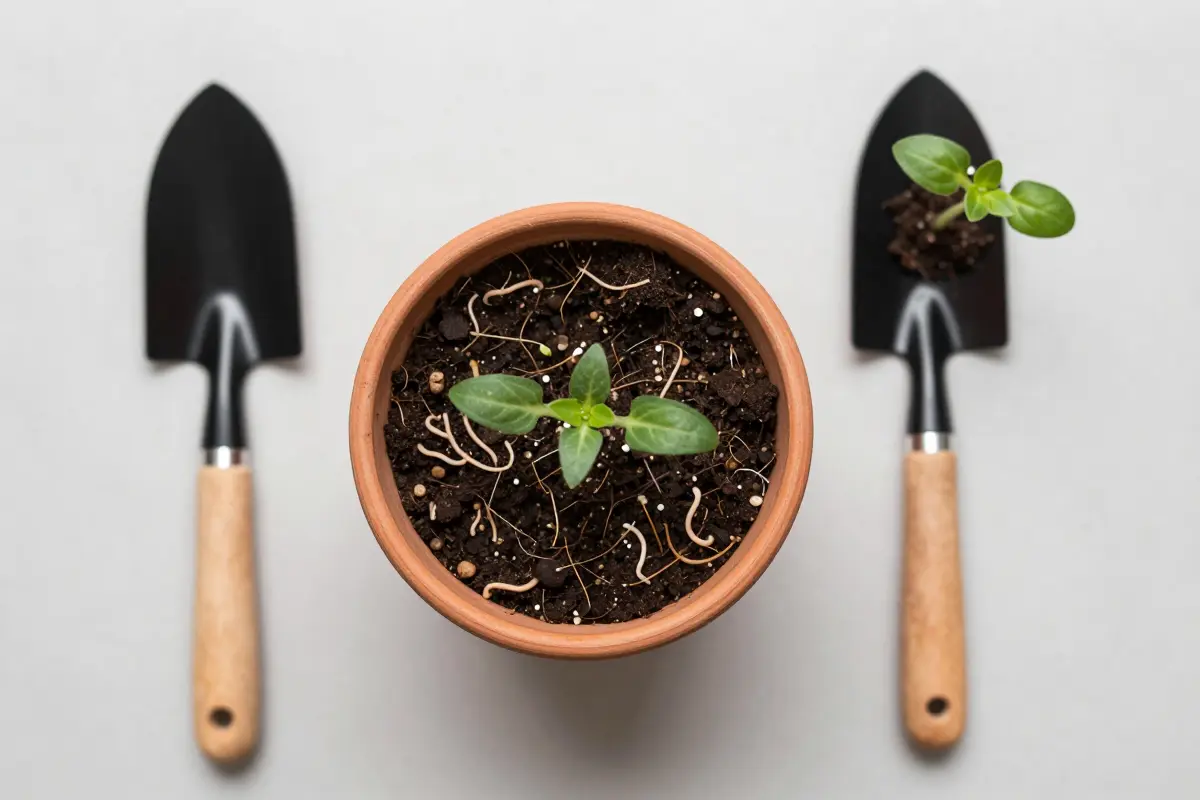
Forget about ordinary garden soil or the kind you find in the park. That soil is usually compacted, may contain pathogens, and doesn’t have the drainage needed for a pot.
- Look for quality: Opt for a good brand of organic universal potting mix or, even better, a mix specifically designed for urban gardens. These come mixed with peat, coconut coir, and perlite, ensuring that the soil is loose and well-aerated.
- The “magic touch”: Worm castings. If you want your tomatoes to burst with flavor and yield, mix the potting mix with 20% worm castings. It’s the best natural fertilizer in the world: it provides slow-release nitrogen, phosphorus, and potassium.
Support or Tutor: The necessary skeleton
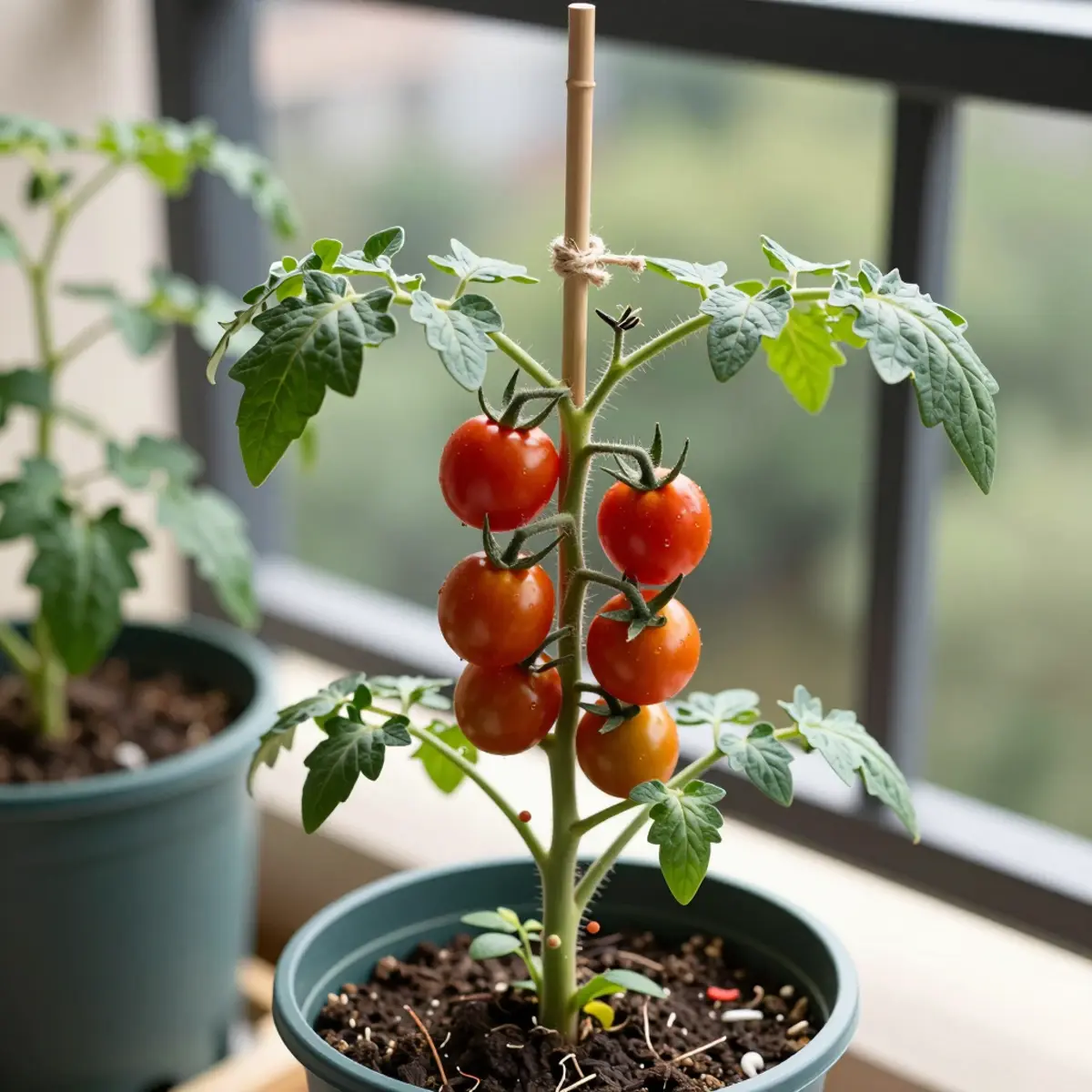
Cherry tomatoes are climbing plants by nature. As the plant grows and the clusters of tomatoes become heavy, the stem can no longer support the weight on its own.
- The solution: A bamboo cane, a wooden stick, or a plastic stake at least 1.5 meters long.
- The tying: Use jute twine or soft cable ties. The goal is to guide the plant, not strangle it.
Everything you need for your cherry tomatoes 🛒
This is what we use for each tomato plant:
- Large pot: 35-40 liter pot. Below 30 liters, the plant suffers in July. You can find models analyzed in the pot comparison .
- Support: spiral support or 1.5-1.8 m cane. Spiral supports save you from having to tie the plant.
- Fertilizer for flowering : organic fertilizer for tomatoes , rich in potassium, every 15 days from when the first flowers appear.
- Potassium soap : ecological potassium soap , for whitefly and aphids.
For substrate and humus, we have comparisons of substrates and worm castings. And if you want to plant two or three tomato plants together, a raised bed is more convenient than three pots: in our raised bed comparison, we explain which one is suitable for tomatoes.
2. Strategic Location: Where the sun works its magic ☀️
If there’s one factor that determines whether you’ll have a resounding success or a green disappointment, it’s light. The tomato is a heliophilic plant, which means it’s a “sun lover.”
- The 6-8 hour rule: Your tomatoes need a minimum of 6 to 8 hours of direct sunlight per day (check the AEMET climate atlas for your region). If you place them in partial shade, the plant will grow, but it probably won’t produce fruit, or the fruit will be green and sour. In the height of July and August, take a look at our urban gardening watering guide for summer to prevent your tomatoes from going thirsty.
- Finding the perfect spot: Observe your terrace for a whole day. Where does the sun shine most of the time? That’s the spot. Avoid placing the planter against walls that cast a shadow for most of the morning.
- The danger of wind: If your terrace is very windy, the support stake is even more critical. Strong winds can break fruit-laden branches or stress the plant. If this is the case, try placing the pot near a wall to provide some protection.
3. From Idea to Land: Planting and First Steps 🌱
Do we start with seeds or is the plant already growing?
This is the eternal dilemma of the grower. Both options are valid, but they depend on your patience:
- Seeds: This is the purist’s route. It allows you to choose the exact variety (red, yellow, black cherry, etc.) and experience the thrill of germination. It requires seed trays and about 4-6 weeks of care before transplanting.
- Nursery plant: This is the ideal “shortcut” for beginners. You buy an established and strong plant. You skip the most delicate phase and go directly to the growth and production phase. We recommend this option for your first experience.
The planting process step by step
- Preparation: Fill your pot with the substrate and humus mixture, leaving about 3-5 cm free to the edge to facilitate later watering.
- Transplanting: Take the plant out of the small nursery pot very carefully so as not to break the root ball (the ball of roots).
- Depth: Bury the plant up to the level of the original root ball. An expert tip is to bury the lower part of the stem slightly; tomatoes have the ability to develop adventitious roots along the stem, resulting in a stronger, more stable plant.
- The first watering: Water generously immediately after transplanting. This helps the roots settle and eliminates air pockets in the soil.
4. Daily Care: The secret to consistency 🌿
Tomatoes don’t require you to spend hours a day tending to them, but they do require consistency. Irregularities are their worst enemy.
The art of irrigation: Neither desert nor swamp
Irrigation is where most growers go wrong. Irrigated watering (letting the soil dry out completely and then flooding it) causes the tomato skin to crack or, worse, blossom-end rot (a black spot at the base of the fruit).
- The finger test: Don’t water by the calendar. Stick your finger in the soil up to the second knuckle. Is it moist? Don’t water. Is it dry? It’s time to give them water.
- Localized watering: Always, always water the base of the plant . Never wet the leaves or fruit. Water on the leaves encourages the growth of fungi like powdery mildew, which can destroy your harvest in just a few days.
- Watering schedule: Water early in the morning or at dusk. Avoid midday, as the water will evaporate quickly and the sun’s magnifying effect could burn the leaves.
The tutor and the growth guide
Don’t wait until the plant is a meter tall to stake it. Do it from the beginning. As the main stem grows, use twine to tie it to the stake in a gentle figure-eight pattern. This allows the stem to sway slightly in the wind without breaking.
Nutrition: Feeding the sweetness
As the plant begins to flower, its needs change. It no longer needs as much nitrogen (to grow leaves), but more phosphorus and potassium (to create flowers and sweet fruit).
- Potassium boost: Use a liquid or granular organic fertilizer rich in potassium every 15 days during the flowering and fruiting phase. This ensures that the tomato isn’t just water, but has that intense, sweet flavor.
5. Pro Maintenance: Pruning and Health ✂️
If you want to go from a “decent crop” to a “professional harvest”, you have to learn how to prune.
The war against “blood-sucking”
Cherry tomatoes are very vigorous and tend to produce side shoots at the angle where the main leaf emerges. These are called “suckers”.
- Why remove them? If you let all the suckers grow, the plant will become a giant bush full of leaves but with very few tomatoes. By removing them, you force the plant to concentrate all its energy on the main fruit clusters.
- How to do it? Simply pinch off the twig with your fingers when it’s small (less than 5 cm). It’s a painless process for the plant and very effective.
Chemical-Free Pest Control
On the terrace, the most common enemies are whiteflies and aphids.
- Natural Solution: Potassium soap and neem oil are your best allies. A mixture of water and potassium soap sprayed on the leaves (top and bottom) once a week is enough to keep them at bay without contaminating your food. You can find the complete protocol in our guide to common urban garden pests.
6. Glory: Harvesting your fruits 🥗
The most anticipated moment has arrived. Picking cherry tomatoes is an almost therapeutic experience.
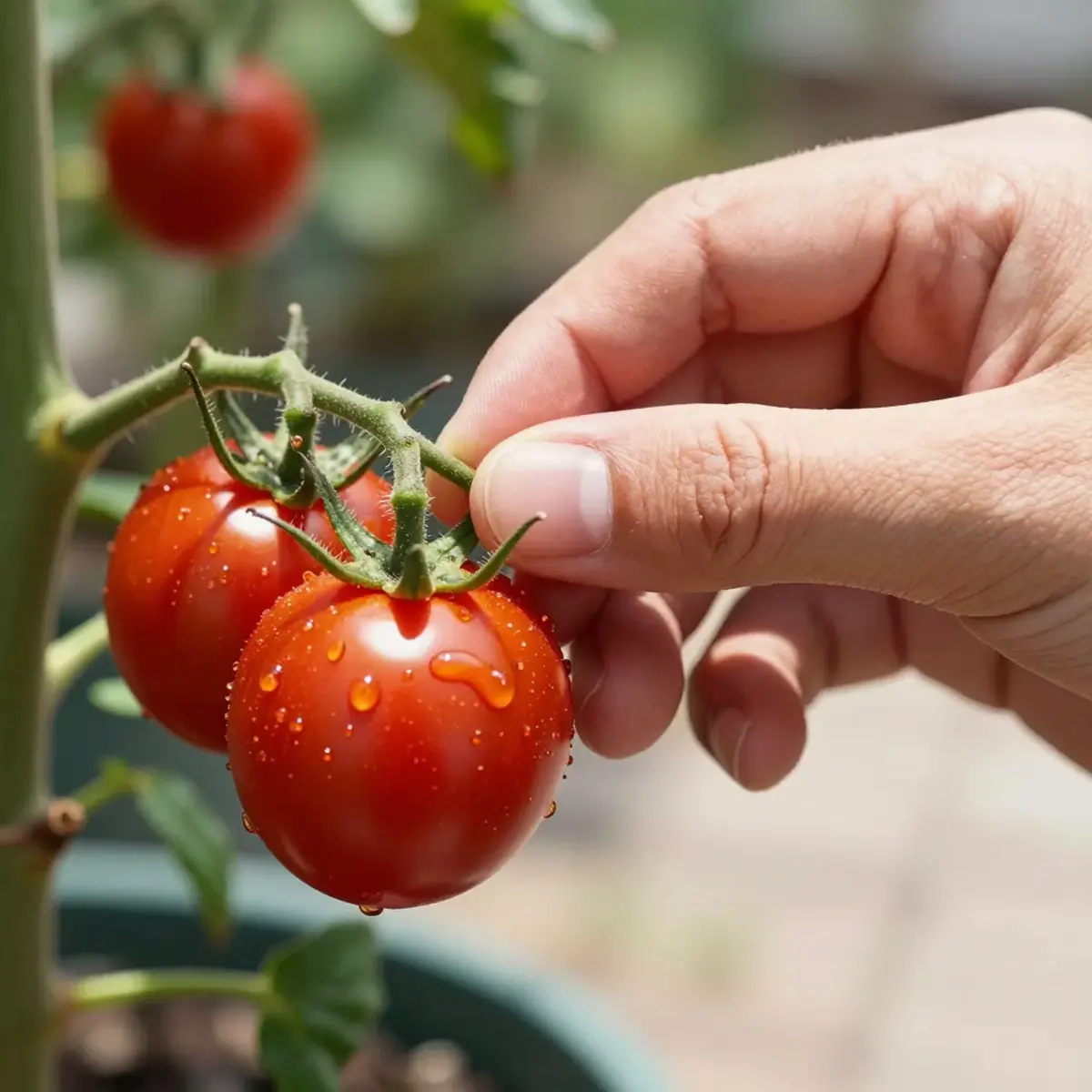
- When to pick? When the fruit has a deep, uniform red color (or the color of the variety you’ve chosen). A trick is to gently squeeze them: if they give slightly to the pressure, they’re at their peak sugar content.
- The technique: Don’t pull the tomato hard, as you could break the stem. Twist it gently until it comes loose on its own.
- Storage: A fatal mistake is putting cherry tomatoes in the refrigerator. The cold breaks down their flavor, making them bland and mealy. Store them in a fruit bowl at room temperature and enjoy them fresh.
FAQ: Everything you always wanted to know about cherry tomatoes ❓
Q: Why are my leaves turning yellow? A: This could be due to two things: either overwatering (the roots are suffocating) or a lack of nitrogen. If the soil is very wet, let it dry out a bit. If it’s dry and yellowing, add some worm castings.
Q: They have flowers, but no tomatoes are appearing. What’s wrong? A: This is called “flower drop.” It can be caused by heat stress (too much heat) or lack of pollination. On the terrace, you can help the plant by gently tapping the flower clusters to move the pollen, or by planting fragrant flowers nearby to attract bees.
Q: Can I grow cherry tomatoes in winter? A: Tomatoes are warm-weather plants. In most places, extreme cold will kill them. If you want to try, you’ll need to put the pot in a greenhouse or indoors near a very sunny window, although the yield will be drastically reduced.
Q: How many tomatoes can I get from a single plant? A: It depends on how well you care for them! A well-cared-for cherry tomato plant in a pot can produce hundreds of fruits throughout the season. It’s one of the most productive plants for the space it occupies.
Q: Is it bad to use chemical fertilizers? A: It’s not “bad” per se, but chemical fertilizers often result in very rapid and weak growth, and can alter the flavor of the fruit. Organic fertilizers nourish the soil and the plant, creating a healthier balance in the long run. If you want to close the loop on your balcony, set up a compost bin or vermicomposter and you’ll have free humus all year round.
Q: What’s the difference between cherry tomatoes and cocktail tomatoes? A: Basically, it’s the size. Cherry tomatoes are the smallest (like grapes), while cocktail tomatoes are an intermediate size between cherry and standard tomatoes. They’re grown in almost the same way.
Are you ready to start your own tomato garden? There’s nothing like the pride of saying, “I grew these tomatoes myself on my terrace!” If you have any questions, leave us a comment below! We’re here to help make your urban garden a resounding success. 🍅✨